Showing posts with label Bangladesh. Show all posts

Saturday, October 27, 2007

Re-calibrating democracy in Bangladesh

Muhammad Zamir
Dhaka Courier, 26 October

The word democracy seems to mean different things to different people. For some it probably connotes the right to exercise one's choice with freedom, albeit responsibly. For others, it appears to suggest the freedom to use acquired power without any restraint or accountability or without the need to function within the due process of law. This difference in interpretation has become for all of us the central point in the re-organization of politics and political behaviour that is normally associated with the dynamics of democracy. We stand today at an important crossroad in our national existence. We are faced with challenges that have to be met and overcome. I am tempted here to refer and compare our current situation with that of Charles Dickens' observation in his incomparable 'Talc of Two Cities'- " It was the best of times. It was the worst of times". He was referring to Paris during the French Revolution. I am referring to Dhaka as it is today.

I have refrained from writing on the evolving and emerging democratic process within our country. I have done so consciously. I have been an interested spectator and watched tile unraveling of political partnerships and political parties. The intensity of the storm that started since the beginning of the year has gradually gained over the last few months. However. there are now hints that a transition and resolution of sorts is on the way.

Some among us have expressed anxiety and concern about the nature of the current process of governance within the country. Others have indicated satisfaction with the current situation. One political analyst from within the preceding category informed me the other day that Bangladesh had lost its democratic status in the eyes of the international community. He suggested that I should write about it. His concern emanated from the fact that we had not been invited to participate (for the first time since 2000, possibly because of our current indeterminate and unusual political status) in the Ministerial Meeting of the 'Community of Democracies' (a global group of 126 active participants and 20 observers) being held in Bamako. Mali in November this year. I have told my analyst friend that he should not read too much into this exclusion. I firmly believe that we will be there in other meetings of this important Group in the future. We will be there after we have completed the many sensitive and delicate tasks, associated with the restoration of a meaningful and functional democracy where the elected representatives will be accountable to the people for their actions.

We still have many miles to go before we can really claim to be a responsible democracy. There are many unresolved issues that need to be addressed. In the meantime we should try to be positive and constructive. We, in our own way, should also assist the current Administration to arrive at just decisions (pertaining to contentious criminal cases filed against important political and business personalities) according to due process of law.

We have a Chief Adviser who has recently dismissed the notion that the country is presently under a dual rule format. It has also been made clear that, despite the continuing status of emergency, he does not perceive any political role for the Armed Forces. The senior leadership of our Armed Forces has also clearly indicated that they are not interested in the taking over of power.

Nevertheless, it is also true that the Armed Forces have been playing an important role in matters of governance- the curbing of corruption, improvement of law and order, marketing of food items and the distribution of flood relief. From that point of view it has been an interesting partnership.

It has been suggested by some that the current Government or some of its Agencies have taken undue interest in the reformation of politics, in the changing of the leaderships of certain political parties within the country and in intimidating certain sections of the media. The Chief Adviser has denied this. We shall accept his view with the hope that the future will not prove his reassurance wrong.

However, it also needs to be noted that chaos prevails today within the two major parties. I personally believe that splintering of the Awami League and the BNP can only lead to the strengthening of the less affected and currently more organised extreme right wing parties who have within themselves extremist and fundamentalist elements. One hopes that the wrong genic is not let out of the proverbial bottle.
In the meantime, we have today, an interesting scenario within our political arena.

The ban on indoor politics has been lifted at least in and around Dhaka. There are still many restrictions that I wish were not present. I personally believe that there should be withdrawal of all restrictions in indoor politicking throughout the country, at least up to the Divisional Headquarters level. This would have been better. This might have facilitated greater exchange of views (at the Council and Executive Committee levels of political parties) on proposed reforms within the electoral process. This would have strengthened the hands of the Election Commission during their ongoing discussions with representatives of different political parties who could have presented their proposals on the basis of broad consensus.

It needs to be remembered that significant issues will have to be resolved by the Election Commission if the forthcoming election is to be considered as credible and fair. Media reports have indicated that the Election Commission is going to propose new provisions and amendments to the Representation of the People Order, 1972. They have a tough year ahead. In addition to the preparing of a corrected electoral roll and the relevant identity cards, they will also have to finalize the basic structure under which the future election will be held. They will also have to decide on sensitive issues like political parties being permitted to continue to have labour and student fronts and the total amount that can be spent by a candidate for his election. This is as difficult as it gets.

The Election Commission has apparently prepared a draft of the amended version of the Representation of People Order, 1972. This will be in the format of the Representation of People Ordinance, 2007. Once promulgated by the President it will acquire the status of law and will be binding in related areas. It has been reported in both the print and the electronic media that the Election Commission will finalize this proposed draft after their ongoing dialogue with the different political parties is competed by the end of November this year.

One can only hope that the Election Commission will be able to ensure that suitable rules are in place that will stop black money and muscle power from determining electoral results. This will necessitate each candidate filing with the Election Commission a detailed report about the current wealth status of the candidate and the immediate members of the candidate's family. There should also be a brief resume about the nature of his socio-economic activities within his prospective constituency and also whether he has ever been prosecuted and sentenced for any form of criminal activity. That should also include whether he is a defaulter of any loan. These details should subsequently be made available in a web page on the computer so that any voter from his constituency can access that page for information. If it is subsequently found that the candidate has filed wrong information or concealed information then his election from the constituency will have to be cancelled. At the end of the day we must have a matrix that will stop fly-by-night businessmen steamrolling their way into the political arena, getting nomination from political parties (on the basis of extortion/donation) and becoming Members of the Jatiyo Sangshad. Politics must not be seen as the pathway to wealth through participatory corruption. It must not also accord to a MP a status where he considers himself being above the due process of law and accountability. Some of the political parties who have very little presence throughout the country will probably term some of the EC's requirements as harsh or even undemocratic but that should not stop the EC from bringing back some order into the system.

The other day for example, one political party suggested to the Election Commission that 'willing candidates from a non-registered party should be allowed to participate in the elections through a registered party. This is absurd. If someone is so keen to participate. that person can always do so as an independent candidate.

The Election Commission and the political parties should also focus in their ongoing discussions on the following factors: (a) the question of having a faced regulatory mechanism pertaining to the receiving of donations by political parties, generating of other forms of revenue by such parties and their eventual expenditure (which has to be made more transparent and should include annual auditing) and (b) the publication of clear manifestos by each political party at least three months before the election date (with regard to their perspective policies on future agricultural initiatives, energy, vocational training and employment opportunities, healthcare, safeguarding of human rights, higher education, dissemination of information technology. improvements to be undertaken in the transport and communications sector, the facilities to be accorded to our hardworking expatriate community and the diversification of our manufacturing capacity and the export base). These manifestos should be devoid of platitudes and focus on real answers to real issues, as they exist both at the District levels and the National level.

We need to move one step ahead in the global race and restore confidence in us within the international community. This will help us again to emerge as a country others can bank on and invest in. Only then will democracy find a meaningful expression.

Muhammad Zamir is a former ambassador and secretary to the government of Bangladesh

Sunday, April 22, 2007

THE FAILED STATE

It’s army rule behind a civilian facade in Bangladesh. And everybody, save the politician, is said to be happy.

SANKAR SEN
The Statesman, 22 April

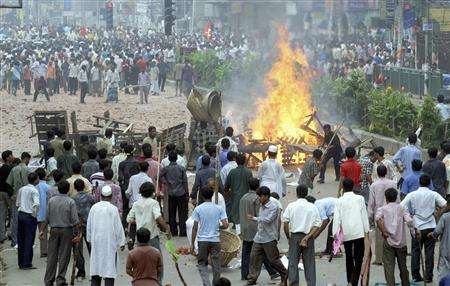
Bangladesh has again come under a military regime though nobody openly calls it a coup. In January this year, the army stepped in and asked President Izazuddin Ahmed, to declare a state of emergency. Basic rights were suspended. The President stepped down as the head of the caretaker government that had been formed to oversee the elections. He was replaced by Fakhruddin Ahmed, a former World Bank official, who now heads a technocratic administration. The army’s intervention had became inevitable following frequent clashes between the supporters of the ruling Bangladesh Nationalist Party and the main opposition party Awami League. The violence had plunged the country into virtual chaos. A dysfunctional Parliament was dissolved. The national security chief, head of the power ministry, and the Attorney-General were ousted. A large number of local gangsters were arrested.

The caretaker government has launched a fullfledged anti-corruption drive. It arrested a large number of senior members of the two ruling parties which had looted and misruled Bangladesh over a decade. Bangladesh, as per Transparency International’s Corruption Perception Index, is regarded as one of the most corrupt countries of the world. In its clean-up drive the military-backed government has already jailed 30 top level criminals, mainly politicians and businessmen. Another 100 are wanted. A law to deal with people, charged with corruption, within 60 days is on the anvil. The government has formed teams of military and civilian investigators for the task and feels confident that they will be able to collect the evidence to get the culprits convicted.

To prove that its anti-corruption drive will spare none, the authorities arrested Tarique Rahman, son of Begum Khaleda Zia. on 9 March. The house of Begum Hasina Wazed, the former Prime Minister and leader of the Awami League, was raided but no arrests were made. The detainees were mostly from the groups that prospered when either Begum Zia or Sheikh Hasina was ruling.

The common people of Bangladesh, who are poor but politically alert, are rejoicing at the discomfiture of the politicians. “Everybody but the politicians”, as the Economist puts it (20-26 January) is apparently happy.

Zia’s son and presumed successor, Tarique, had in recent years become the symbol of corruption, violence and kleptocratic misrule. He was referred to as “Mr ten per cent”, because of his cut in any deal effected by the government. Indeed, the people had become sick of corruption and the spiraling violence.

The caretaker government has vouched to de-politicise the enfeebled institutions. It has appointed a new election commission and has also weeded out Khaleda’s acolytes who were in charge of the government’s anti-corruption wing. It has announced plans to make the state banks accountable and recover the money from the politicians and their cronies who had taken massive loans and were reluctant to pay back. Initially the caretaker government also announced a clamp on the media, but good sense prevailed and it decided to relax it. The administration has also taken a number of other sensible steps. It is trying to deal with the looming power crisis and overhaul the malfunctioning seaport at Chittagong. For dealing with the chronic power shortage it has approved a long pending deal with an Indian firm to build a 240 MW power station.

It seems that the army’s objective is to force the two ladies to quit by starting corruption cases against them. The strategy has been nicknamed as “Musharraf solution”, after the success of Musharraf, in forcing two redoubtable civilian leaders Benazir Bhutto and Nawaz Sharif to leave Pakistan. Latest reports suggest that Khaleda has agreed to go into exile in Saudi Arabia. Sheikh Hasina has left Bangladesh, and is unlikely to return soon.

The army is proceeding carefully and is not going to allow elections to be held within a year. The National Democratic Institute, a US based monitoring group, discovered in December that the electoral roll in Bangladesh has 13 million bogus names. Even the BNP concedes that there are problems with the electoral rolls.

Revision of the voters’ list will take several months and the administration says it wants to issue fraud-proof identity cards. This will take more than a year. It is clear that the army, though not apparent on the face of it, would like to extend its rule. It will not be easy to send it to the barracks.

The administration has announced the setting up of a National Security Council which will include the chiefs of three services and also civilians led by the head of the interim government, Fakhruddin Ahmed. The new council gives the army a formal mechanism for effectively controlling the administration that it has installed in January 2007. The army top brass feels that it is not possible to govern the country from behind the curtain any longer. It fears a backlash by the BNP loyalists.

With the decline of the influence of the BNP there is now a political void. Md Yunus, who recently won the Nobel Peace Prize, for his pioneering work on micro-credit, is trying to build up a new political force. But this will need the army’s backing which Yunus wants to avoid. Commenting on Yunus’ plan, Hasina has remarked ~ tongue firmly in cheek ~ that she saw “no difference between usurers and corrupt people”.

For the time being the people in Bangladesh have appreciated the emergency arrangements. Western governments and donors are also happy; they feel that an emergency for a year or so will reinvigorate Bangladesh’s crippled institutions.

However, this is a dangerous state of affairs. Army rule is an anachronism in the 21st century. Further, the BNP has many loyal supporters within the army, judiciary and other institutions. They are sulking at the moment; they do not want the present regime to succeed. The BNP still has its men in key positions, in addition to a fair amount of money and popular support across the country.

Though Bangladesh is a Muslim country with liberal and secular traditions, the fundamentalist Islamic groups and parties in recent years, and particularly during Begum Zia’s rule, have gained disproportionate influence. The Jamat-e-Islami and its violent student wing, Chatra Shibir, which controls the campuses of some of the important universities, have acquired both money and muscle power.

For a country like Bangladesh prolonged army rule will do more harm than good. The initial relief will gradually wear off. To remain in power and to marginalise the main political parties the army may have to join hands with the fundamentalist groups as it has done in Pakistan. Jihadis adore a vacuum. Disillusionment with the main political parties will strengthen their hands. Bangladesh is far from being a hardline Islamic state but its so-called secular leaders have done their best to give secularism a bad name.

Authoritarian rule is unlikely to appeal for long, despite the disenchantment of the voters with the two mainstream political parties. The socio-economic problems of Bangladesh are overwhelming. By 2050, its population s projected to reach 250 million. Only democratic rule and institutions can help the country tackle its burgeoning problems.

India has a big stake in the goings-on. It wants a stable and friendly neighbour. Bangladesh has harboured many insurgent groups from the North-east and sheltered many fugitives from India. It is learnt that the present regime will try tio mend fences with India.

At a recently concluded conference between the senior officers of the BSF and BDR, the latter stressed the need for improved relations with India. But the acid test is the willingness of Bangladesh to firmly curb the activities of the terrorist outfits operating against India. Present indications are encouraging.

A Senior Fellow, Institute of Social Sciences, the author had served as Director, National Human Rights Commission, and the National Police Academy.

Sunday, January 14, 2007

Economist heads Bangladesh government

Haroon Habib
The Hindu, January 13

New council of advisers to be appointed; fresh poll date will be announced later


DHAKA: An acclaimed economist, Fakhruddin Ahmed, 66, was on Friday sworn in the new head of the non-party caretaker government in Bangladesh, where the political situation is volatile. He is the former Governor of the Bangladesh Bank and a former World Bank executive.

President Iajuddin Ahmed, who on Thursday declared a state of emergency amid political unrest and resigned as the chief of the caretaker government, conducted the swearing-in ceremony at the President's palace Bangabhaban here.

As nine of Mr. Iajuddin Ahmed's 10-member council of advisers resigned en masse, the new chief adviser will appoint his team and hold the national elections, the date for which will be announced later.

The swearing-in was attended by all top leaders of the grand alliance led by Sheikh Hasina, but the former Prime Minister Khaleda Zia and her party and alliance leaders abstained.

The reverse scenario was witnessed when President Iajuddin Ahmed was sworn in on October 29 last to take the additional responsibility of caretaker government.

In the changed situation, the chiefs of the National Security Intelligence and President's Guards Regiment, loyal to the Khaleda Zia Government, have been removed. There are unconfirmed reports of arrests and confinement of some key leaders from both political camps.

Saturday, January 06, 2007

Bangladesh: Hell-bent on creating chaos

The Hindu, January 6

The Bangladesh President, Iajuddin Ahmed, appears hell-bent on throwing the country into chaos. Mr. Ahmed, who heads the caretaker government, has the responsibility of ensuring that the parliamentary elections scheduled for January 22 are free and fair. Instead, his partisanship with the Bangladesh National Party-Jamaat Islami combine was so flagrant that the opposition parties were left with no choice but to boycott the election. While the President came up with a few cosmetic measures initially, he refused to give ground on most of the eminently reasonable demands made by the Awami League-led 14 party alliance. Electoral officers known to be partisan were not replaced; voters' lists were not revised; and appointees of the BNP were not removed from key administrative posts. The rejection of the nomination papers of H.M. Ershad, the former President, was the last straw. This move convinced even those parties that were not part of either alliance that while the poll processes might seem above board, the result would be rigged in favour of the BNP-Jamaat combine. Under the circumstances, participation in the electoral exercise would only legitimise electoral manipulation and fraud in favour of the BNP.

However, Mr. Ahmed appears determined to press ahead, come what may. The BNP-Jamaat combine has swung round to the view that their allied status is a hindrance to their ambitions. With the boycotting parties withdrawing nominations, many of the combine's candidates have already been declared winners in their constituencies. The alliance has now decided that while the BNP will project itself as the prospective ruling party from now on, the Jamaat will pose as the opposition. The unbelievable chutzpah of these parties might not take them far. With the boycotting parties deciding to enforce a two-day countrywide blockade from January 7, there is a clear likelihood of violence breaking out in Bangladesh. The situation could turn explosive if the boycotting parties carry out their plan to resist the election. An outbreak of violence could give the military an opportunity to intervene. The armed forces, which are under orders to deploy to district headquarters from January 10, have so far not shown any interest in getting involved in the political showdown. The generals know that if they take power, their forces will have to be withdrawn from international peace-keeping operations that are a lush source of income. While major political turbulence seems unavoidable, the hope is that Bangladeshi democracy will emerge stronger at the end of it. This can happen only if the reactionary BNP-Jamaat combine is forced out of power by a people's revolt combining with international pressure on the side of democracy.

Monday, January 01, 2007

Bangladesh: Crisis to crisis

Chronic instability has dogged Bangladesh ever since its creation. At the root of this malady is an acute crisis of national identity. A Pakistan era legacy, it embodies a running conflict between secular propensity and fundamentalist Islamic ethos in the Bengali Muslim psyche. Right from the time when the proponents of political Islam sided with the marauding Pakistan army in 1971, this clash of ideology between the pro-liberation and anti-liberation forces has overshadowed the country’s socio-political dynamics, frequently igniting turmoil and violence.
Independence from Pakistan marked the victory of secularism over Islamic theocracy, but throughout its 36-year-long history Bangladesh has had no respite from the fierce ideological cleavage. The post-Mujib military rulers ~ Ziaur Rehman and Hussein Mohammed Ershad ~ systematically played the Islamic card at home and abroad with an eye on consolidating their respective hold on power.
Ban lifted
Zia de-secularised the Constitution and legitimised the fundamentalist and communal parties (1977) by lifting the ban on their functioning. Ershad declared Islam as the state religion (1988). Both promoted close ties with Pakistan, Saudi Arabia and the rest of the Muslim world, which stoked the growth of radical Islam. A generous flow of petro-dollars from West Asia ever since has helped create a strong network of mosques and madrasas as the fulcrum of militant Islam. While the Jamaat-e-Islami mobilised Muslims on the hardline Wahbbi platform, the centre-left mainstream remained quiescent about it, lest countervailing response from them cut into their electoral support base in the majority Muslim community.
A secret marriage of convenience between the Jamaat and the rightist BNP during the first regime of Begum Khaleda Zia (1991-96) radicalised the anti-liberation forces. Ascension of the Jamaat to the state power structure as a partner of the BNP-led four-party coalition government (2001-2006) has promoted the menace of Islamist terror that threatens the stability of Bangladesh and the rest of the sub-continent.
Since the ouster of Ershad, as the sequel to an all-party mass movement three general elections (1991, 1996 and 2001) have been held in Bangladesh. The last two were conducted by a neutral interim government prescribed by an amendment of the Constitution (1996) to ensure a free and fair poll. The BNP won the1991 election and the BNP-led four-party alliance the 2001 poll whereas the Awami League won the 1996 election.
The January 2007 has run into rough weather, mainly due to the partisan role of the country’s President, Iazuddin Ahmed, and the irreconcilable face-off between the Awami League-led 14-party alliance and the BNP-led four-party combine.
The anti-incumbency factor had played a crucial role in deciding the outcomes of the 1996 and 2001 elections. Given the disastrous performance of the BNP-Jamaat government marked by unprecedented rise in unemployment and runaway inflation, unbridled corruption, extra-judicial killings by the security forces and the no-holds-barred growth of the Islamist jihad, the 14-party alliance was expected to win in a reasonably free and fair election.
To avoid the defeat of the BNP-led combine, President Iazuddin Ahmed has been resorting to patently partisan actions, making a mockery of the Constitution and the neutrality on the interim government. On remission of office by the outgoing BNP-Jamaat government, the President formed a ten-member Advisory Council, appointing himself the chief adviser of the interim government. Though under the Constitution he is a titular head of the state, currently he is also the home, defence and foreign minister as well as commander-in-chief of the armed forces. This extraordinary concentration of power in one hand is a serious violation of the Constitution and doesn’t bode well for the country’s stability in the run-up to the elections and after.
As some of the advisers appointed by the President were closely connected with the BNP, they were unacceptable to the Awami League and its allies. Iazuddin’s partisan handling of the demand for their removal fuelled the mass movement on the issue spearheaded by the Awami League-led alliance. His lack of transparency and conspiratorial way of functioning, shutting out the advisers from policy-making, vitiated the working atmosphere of the interim government, forcing four advisers to resign.
Prolonged, unseemly wrangling between the President and the 14-party alliance over the latter’s demand for the removal of undesirable persons positioned as election commissioners exacerbated the distrust of Iazuddin Ahmed. Seen as busy implementing the BNP-Jamaat blueprint to rig the poll, the chief adviser is keen to deploy the army in the conduct of the election. Military intervention in any form in the election process is anathema to all parties except the BNP and its allies. The previous Khaleda Zia government was reported to have drafted declarations for the deployment of the army and promulgation of a state of emergency before laying down office.
A move by the President to call in the army was foiled by the agitating fourteen-party alliance. Later, half way through the three-month tenure of the interim government, the President deployed the army purportedly in aid of the civilian administration, but in reality it was a move to thwart the ongoing mass movement against his ill-motivated acts of omission and commission.
After changing the election schedule several times it has been fixed for 22 January, but the electoral roll prepared by the previous BNP-Jamaat regime was found to be a recipe for vote fraud. Names of hundreds of thousands of genuine voters, notably from the minority Hindu community, considered supporters of the Awami League, have been deleted from the voter list and an equally large number of fake voters has been enlisted.
One thing that will boost the Awami League’s chances is that the BNP has split and lost much of its steam. A new political force, the Liberal Democratic Party (LDP), led by Badruddozza Chowdhury, a former President, and Oli Ahmed, a senior BNP leader, is campaigning on an anti-corruption platform. The new party will significantly reduce the BNP-Jamaat votes. The joining of the grand alliance by the LDP and the Jatiya Party of Ershad will further consolidate the anti-BNP-Jamaat vote.
Houses burnt
Begum Zia’s son, Tarique Rahman is the strong man of the BNP. At least four BNP defectors to the LDP have seen their houses burned down in a campaign of intimidation by Tariqe’s followers.
The system of a caretaker government was introduced to safeguard democracy from the winner-takes-all instincts of the two big parties, but now that very system has become part of the threat. Most foreign concerns about Bangladesh in recent years have been focused on the spread of violent Islamic extremism. The recent events have inspired the fear of a breakdown of the fragile political order, leading to a messy deadlock or military intervention, and a field-day for the Islamic terrorist outfits. Given the volatile situation, two predictions can be made with reasonable certainty: (1) Even if the elections are held on time, the losers ~ i.e. one of the two mainstream groupings ~ will reject the results and violent political unrest shall continue; (2) The election campaign and polling will witness extreme violence and, going by the experience of the 2001 election, recurrence of uncontrolled Hindu cleansing is a foregone conclusion.
Many panic-stricken members of the minority community have crossed over to India in the past few weeks. The influx will have a particularly disturbing impact on Assam, Meghalaya, Tripura and West Bengal. From all indications New Delhi and the state governments have no contingency plan to cope with the tide of refugees.
The author is former Additional Secretary, Research and Analysis Wing (RAW)

Wednesday, November 01, 2006

Bangladesh

Blocage et forte tension au Bangladesh, entre le président et l'opposition


LEMONDE.FR avec AFP 29.10.06 19h28

Le président bangladais Iajuddin Ahmed, après avoir consulté dimanche 29 octobre les chefs des principaux partis du pays, a décidé d'assumer lui-même la direction du gouvernement intérimaire. Depuis vendredi, de violents affrontements ont fait 18 morts.

La Ligue Awami, le principal parti d'opposition, a aussitôt appelé à des manifestations et à une paralysie des transports lundi dans l'ensemble du pays. L'opposition, qui regroupe une alliance de treize partis, contestait la désignation à la tête du gouvernement intérimaire de l'ex-président de la Cour suprême K. M. Hasan, un ancien membre du Parti nationaliste du Bangladesh (PNB, au pouvoir), qu'elle accuse de partialité.

La tâche principale du gouvernement provisoire est l'organisation des élections législatives de janvier 2007. Au cours d'une brève cérémonie organisée au palais présidentiel et retransmise à la télévision, Iajuddin Ahmed a prêté serment "en tant que conseiller en chef du gouvernement intérimaire neutre", devant le président de la Cour suprême J.R. Mudassir et le Premier ministre sortant Khaleda Zia.

Depuis la défaite de la Ligue Awami aux dernières élections en octobre 2001, le Bangladesh (144 millions d'habitants, dont plus de 85 % de musulmans) est gouverné par une coalition de quatre partis (dont deux formations islamistes) conduite par le PNB de Mme Zia.

L'OPPOSITION APPELLE AU BLOCAGE

Les violences ont éclaté vendredi soir à l'expiration du mandat de cinq ans de Mme Zia, censée céder samedi les rênes du pouvoir au gouvernement intérimaire. Les heurts entre ses partisans, ses adversaires et les forces de police ont fait au moins dix-huit morts et plusieurs centaines de blessés à Dacca et dans plusieurs autres villes du pays.

Dimanche, deux jeunes hommes ont été battus à mort sur l'île de Nijhum Dwip, dans le sud, et un troisième a été tué à l'arme blanche sur l'île de Hatiya, également dans le sud. Une quatrième personne a succombé à ses blessures après avoir été lapidée la veille dans la région de Pirojpur, également dans le sud, selon la police.

La prestation de M. Hasan, qui devait devenir premier ministre provisoire, avait été différée samedi, officiellement pour raisons de santé, avant que le gouvernement n'annonce finalement "l'incapacité" de M. Hasan à diriger l'administration intérimaire.

L'opposition exige en outre un droit de regard sur la composition de la Commission électorale, qui supervisera le scrutin de janvier, jugée trop favorable au gouvernement sortant.

Pour tenter de sortir de l'impasse, le chef de l'Etat avait déjà proposé d'assurer lui-même la direction du gouvernement intérimaire, mais cette solution avait été rejetée par la Ligue Awami, qui a boycotté dimanche sa prestation de serment.

Faute d'un accord avec le parti au pouvoir, la Ligue a appelé à un blocus des transports et à des manifestations lundi dans l'ensemble du pays. Elle avait déjà organisé ces derniers mois une série de grèves et de manifestations dont la plus importante a réuni 100 000 personnes le 18 septembre.

Selon les autorités, des barrages ont déjà été installés sur les principaux axes routiers et toutes les activités du port de Chittagong (sud) sont au point mort. A Dacca, théâtre samedi de véritables batailles rangées, les rues étaient quasiment désertes dimanche et la plupart des habitants sont restés cloîtrés chez eux dans la crainte d'une nouvelle flambée de violences.

Bangladesh

Au Bangladesh, affrontements et grèves plongent le pays dans la crise politique

LE MONDE 30.10.06 14h26 • Mis à jour le 30.10.06 14h26
ISLAMABAD CORRESPONDANTE EN ASIE DU SUD

Pour mettre fin aux violences qui ont fait une vingtaine de morts et plus de cent blessés à travers le pays, le président du Bangladesh, Iajuddin Ahmed, s'est nommé lui-même, dimanche 29 octobre, chef du gouvernement intérimaire chargé d'organiser dans les trois mois les élections législatives. La mise en place de cet exécutif de transition avant le scrutin est imposée par la Constitution. La nomination du chef de l'Etat, qui règle l'impasse politique née du refus de l'opposition d'accepter à ce poste l'ancien président de la Cour suprême, K. M. Hasan, jugé trop favorable au gouvernement, ne met toutefois pas fin à la crise.

L'opposition, conduite par la Ligue Awami de l'ancien premier ministre Cheikh Hasina, a boycotté la prestation de serment du président et appelé à des manifestations et à une grève des transports lundi. Alliée à treize autres partis d'opposition, la Ligue Awami, qui avait, dans les semaines précédentes, refusé la nomination du président comme chef du gouvernement intérimaire, a quand même, cette fois, décidé d'attendre et de voir. "Le président aurait dû nommer quelqu'un d'autre à ce poste. Cependant nous espérons que le président agira de façon impartiale pour conduire les prochaines élections", a affirmé Cheikh Hasina. L'opposition exige un droit de regard sur la composition de la commission électorale trop favorable, selon elle, au gouvernement sortant.

La première ministre sortante, Khaleda Zia, du Bangladesh Nationalist Party (BNP), a terminé officiellement ses cinq ans de mandat vendredi soir en appelant au calme dans un discours radiotélévisé. "Nous voulons que la paix continue d'être assurée dans ce pays, en particulier avant les prochaines élections. Sauvegardez la paix !", avait exhorté Mme Zia, dont le mandat a été constamment perturbé par des manifestations et grèves organisées par l'opposition. Son parti avait agi de la même façon pendant les cinq ans précédents, quand Cheikh Hasina était au pouvoir.

Depuis son indépendance, gagnée sur le Pakistan avec l'aide de l'Inde, en 1971, le Bangladesh a connu une série de coups d'Etat militaires avant de revenir à un régime démocratique chaotique en 1990. Le BNP de Khaleda Zia et la Ligue Awami de Cheikh Hasina, qui ont dominé depuis lors la vie politique, ont en effet, comme l'affirme, dans un récent rapport, l'International Crisis Group (ICG), "échoué à respecter les normes et le fonctionnement démocratiques, que ce soit au gouvernement ou dans l'opposition". Le Parlement a été paralysé à plusieurs reprises par le boycottage de l'opposition, quelle qu'elle soit. Le dysfonctionnement du BNP et de la Ligue Awami, qui restent des partis très personnalisés, a favorisé l'émergence de partis islamistes. Depuis 2001, le Bangladesh était gouverné par le BNP, allié, notamment, à deux partis islamistes.

Cette nouvelle crise fait craindre à certains un retour aux affaires de l'armée - qui conserve, en coulisse, une influence notable - bien que celle-ci, comme le note l'ICG, ne souhaite sûrement pas prendre le risque de remettre en question ses opérations onusiennes de maintien de la paix.
Dans le climat actuel d'incertitude, les milieux d'affaires ont, dimanche, exprimé leur inquiétude sur les conséquences de la situation sur l'économie. Déjà, selon les autorités, toutes les activités du port de Chittagong (sud) sont gelées. Le Bangladesh reste l'un des pays les plus pauvres du monde, et la moitié de ses 144 millions d'habitants vivent avec 1 dollar par jour.

Françoise Chipaux

Bangladesh

27 hauts fonctionnaires du gouvernement Zia virés par le Président du Bangladesh

Le Président du Bangladesh, Iajuddin Ahmed a viré ou muté 27 hauts fonctionnaires le premier jour de sa prise de fonction en tant que chef du gouvernement par intérim afin de prouver sa neutralité vis-à-vis des adversaires du BNP, le parti dirigé par l’ancien Premier ministre, Khaleda Zia.

Le directeur général de la force de l’ordre (RAB) et le chef des intelligences policières ont été expulsés de leurs responsabilités. « Le Président s’est mis à répondre à des revendications. » a dit, mardi, un des secrétaires d’État.

Iajuddin a été assermenté le dimanche avant d’assumer sa nouvelle fonction dans le gouvernement provisoire chargé de surveiller les élections législatives de janvier 2007 dans un pays quasiment déplumé qui compte en plus 140 millions d’habitants.

Cependant, Awami Ligue, le principal parti opposant et ses alliés avaient exigé que le Président, jugé favorable au BNP, fasse preuve de sa neutralité et sa fiabilité avant le 3 novembre.

Dans son nouveau rôle, Iajuddin sera assisté par un groupe de 10 conseillers choisis parmi des personnes nommées par les plus importants des partis politiques du pays. Un porte-parole du Palais présidentiel a annoncé que les listes des conseillers avaient déjà été remises au Président par ceux-ci. « Dès qu’elle sera finalisée, les conseillers seront convoqués pour faire office. » a dit le porte-parole.

Tuesday, October 31, 2006

Bangladesh

Emeutes Sévissent au Bangladesh, La Capitale en Etat d’Urgence


Bangladesh dont la superficie ne dépasse guère un tiers de celle de l’Hexagone et dont les habitants vivant au-dessous du seuil de pauvreté comptent 47% de la population, est actuellement en proie à un bouleversant politique et social inouï avant ses élections législatives en janvier 2007.

De violents affrontements politiques ont éclaté le 28 octobre au Bangladesh ayant provoqué la mort d’une vingtaine de personnes et fait plus d’un millier de blessés jusqu’à ce moment. Le mandat de cinq ans du Premier ministre, Khaleda Zia, expiré, le gouvernement au pouvoir aurait donc à confier samedi les rênes à un gouvernement provisoire chargé d'organiser des élections législatives en janvier 2007.

Cependant, la violence ne venait de se déchaîner qu’à la suite de la nomination de K. M. Hasan, L'ex-président de la Cour suprême du Bangladesh, en tant que leader du gouvernement gardien, qui s'apprêtait à être assermenté avant d’enter en fonction.

La situation actuelle est donc extrêmement explosive. Hier et avant-hier, les rues de la capitale, Dacca, avaient été bousculées de nombreux incidents sanglants entre les partisans de Zia et ceux de leur principal adversaire Awami Ligue .

Malgré le déploiement de milliers de policiers et l’usage abondant de gaz lacrymogène pour rétablir la paix, la police a avoué avoir été complètement inefficace et impuissant devant cet accès de violence dont un des responsables de la force de l’ordre bangladaise pense : « les incertitudes vont persister et la tension, s’accentuer ».

Dans une déclaration faite au média national, Hasan a dit qu’il avait renoncé à assumer sa fonction dans le gouvernement par intérim comme il n’avait pas réussi à se rendre crédible devant un certain nombre de partis politiques.

Le Président du Bangladesh, Iazuddin Ahmed, après avoir vainement convoqué tous les partis politiques du pays pour discuter la crise, avant-hier, s’est déclaré, lui-même, le chef d’Etat en s’emparant de la fonction du Premier ministre, une décision qui a été aussi vivement soutenue par le parti de Khalida Zia que décrié par ses opposants qui disent que l’action du Président est foncièrement inconstitutionnelle.

L'opposition exige en outre un droit de regard sur la composition de la Commission électorale, qui supervisera le scrutin de janvier 2007, jugée trop favorable au gouvernement sortant.

Depuis hier, la capitale du pays, effectivement en état d’urgence, est restée encerclée, empêchant le public et les transports d’en sortir ou d’y rentrer librement. L’inde, le plus proche voisin du pays, en exprimant ses inquiétude sur les instabilités du Bangladesh et souhaitant que le prochain scrutin de janvier se déroule en paix, a néanmoins renforcé la vigilance aux frontières de deux pays.


27 hauts fonctionnaires du gouvernement Zia virés par le Président du Bangladesh

Le Président du Bangladesh, Iajuddin Ahmed a viré ou muté 27 hauts fonctionnaires le premier jour de sa prise de fonction en tant que chef du gouvernement par intérim afin de prouver sa neutralité vis-à-vis des adversaires du BNP, le parti dirigé par l’ancien Premier ministre, Khaleda Zia.

Le directeur général de la force de l’ordre (RAB) et le chef des intelligences policières ont été expulsés de leurs responsabilités. « Le Président s’est mis à répondre à des revendications. » a dit, mardi, un des secrétaires d’État.

Iajuddin a été assermenté le dimanche avant d’assumer sa nouvelle fonction dans le gouvernement provisoire chargé de surveiller les élections législatives de janvier 2007 dans un pays quasiment déplumé qui compte en plus 140 millions d’habitants.

Cependant, Awami Ligue, le parti opposant principal et ses alliés avaient exigé que le Président, jugé favorable au BNP, fasse preuve de sa neutralité et sa fiabilité avant le 3 novembre.

Dans son nouveau rôle, Iajuddin sera assisté par un groupe 10 conseillers choisis parmi des personnes nommées par les plus importants des partis politiques du pays. Un porte-parole du Palais présidentiel a annoncé que les listes des conseillers avaient déjà été remises au Président par ces principaux partis. « Dès qu’elle sera finalisée, les conseillers seront convoqués pour faire office. » a dit le porte-parole.