Monday, July 30, 2007

6 killed in police firing


S. Nagesh Kumar
The Hindu, July 29

Left-sponsored bandh turns violent in Andhra Pradesh


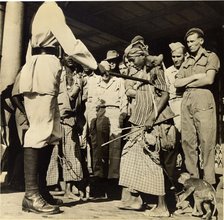
Tragedy: The bodies of the victims of the police firing at Mudigonda village, Andhra Pradesh, being taken to hospital.

HYDERABAD: Six persons were killed on the spot in police firing at Mudigonda village in Andhra Pradesh as a Statewide bandh called by the Left parties, as part of their three-month-old land struggle, took a violent turn on Saturday.

The police opened 70 rounds of fire at Mudigonda in Khammam district, a stronghold of the Communist Party of India (Marxist) and the Communist Party of India, after fighting a pitched battle with the demonstrators, who earlier ransacked the office of the Revenue Divisional Officer.

The provocation for the firing was a mob attack on the jeep of the Additional Superintendent of Police M. Ramesh Babu, who rushed to the village with reinforcements.

Seven others were injured, three of them seriously, in the firing, apart from several persons who were hurt in a lathi charge. Leaders of the Left parties shifted the bodies of the victims to Khammam, 20 km away, and placed them outside the Government General Hospital. There was a tense stand-off between the police and the demonstrators at the Collectorate located opposite the hospital.

In the adjoining Nalgonda district, Communist cadres stoned and damaged 15 buses of the state-owned A.P. State Road Transport Corporation.

In all, 54 buses were damaged across the State and hundreds of Left activists rounded up during the bandh, which disrupted normal life in several parts of Andhra Pradesh.

Judicial probe ordered

Expressing anguish at the deaths, Chief Minister Y.S. Rajasekhara Reddy announced a judicial inquiry into the Mudigonda police firing and ordered the transfer of Superintendent of Police R.K. Meena and suspension of Mr. Ramesh Babu. He said at a press conference that the police had not heeded his advice to observe restraint during the bandh. The scale of violence took the Government by surprise since it occurred in the midst of its talks with the Left parties that went on till Friday night. Both sides were expected to resume the parleys on Saturday morning.

But the Government forcibly removed CPI (M) State secretary B.V. Raghuvulu and CPI State secretary K. Narayana from their hunger strike camp here at 1 a.m. on Saturday. These leaders had been on hunger strike for six days demanding the constitution of an independent commission with quasi-judicial powers to deal with land reforms. The Government did not concede the demand saying the commission would become a parallel body in revenue administration.

Instead, it agreed to appoint a Special Commissioner to deal with land-related issues. As there was no consensus after three rounds of talks, the Left parties went ahead with the bandh that was supported by the Telugu Desam Party.

Bet on India

The Bush administration presses forward with a nuclear agreement -- and hopes for a strategic partnership.

Washington Post, July 29

IN LARGE PART, modern U.S. nuclear nonproliferation policy began with India. India received U.S. aid under the "Atoms for Peace" program of the early Cold War era -- only to lose its U.S. fuel supply because India, which had refused to sign the 1968 nuclear Non-Proliferation Treaty (NPT), exploded a nuclear "device" in 1974. Decades of U.S. noncooperation with India's civilian atomic energy program were intended to teach India, and the world, a lesson: You will not prosper if you go nuclear outside the system of international safeguards.

Friday marked another step toward the end of that policy -- also with India. The Bush administration and New Delhi announced the principles by which the United States will resume sales of civilian nuclear fuel and technology to India, as promised by President Bush in July 2005. The fine print of the agreement, which must still be approved by the 45-nation Nuclear Suppliers Group and by Congress, has not yet been released. But the big picture is clear: The administration is betting that the benefits to the United States and the world of a "strategic partnership" with India outweigh the risks of a giant exception to the old rules of the nonproliferation game.

There are good reasons to make the bet. India is a booming democracy of more than 1 billion people, clearly destined to play a growing role on the world stage. It can help the United States as a trading partner and as a strategic counterweight to China and Islamic extremists. If India uses more nuclear energy, it will emit less greenhouse gas. Perhaps most important, India has developed its own nuclear arsenal without selling materials or know-how to other potentially dangerous states. This is more than can be said for Pakistan, home of the notorious A.Q. Khan nuclear network.

You can call this a double standard, as some of the agreement's critics do: one set of rules for countries we like, another for those we don't. Or you can call it realism: The agreement provides for more international supervision of India's nuclear fuel cycle than there would be without it. For example, it allows India to reprocess atomic fuel but at a new facility under International Atomic Energy Agency supervision, to protect against its diversion into weapons. The case for admitting India to the nuclear club is based on the plausible notion that the political character of a nuclear-armed state can be as important, or more important, than its signature on the NPT. North Korea, a Stalinist dictatorship, went nuclear while a member of the NPT; the Islamic Republic of Iran appears headed down the same road. Yet India's democratic system and its manifest interest in joining the global free-market economy suggest that it will behave responsibly.

Or so it must be hoped. The few details of the agreement released Friday suggest that it is very favorable to India indeed, while skating close to the edge of U.S. law. For example, the United States committed to helping India accumulate a nuclear fuel stockpile, thus insulating New Delhi against the threat, provided for by U.S. law, of a supply cutoff in the unlikely event that India resumes weapons testing. Congress is also asking appropriate questions about India's military-to-military contacts with Iran and about New Delhi's stubborn habit of attending meetings of "non-aligned" countries at which Cuba, Venezuela and others bash the United States. As Congress considers this deal, India might well focus on what it can do to show that it, too, thinks of the new strategic partnership with Washington as a two-way street.

Saturday, July 28, 2007

What I Didn't Find in Africa

Published on Sunday, July 6, 2003 by the New York Times
Joseph C. Wilson 4th

Did the Bush administration manipulate intelligence about Saddam Hussein's weapons programs to justify an invasion of Iraq?

Based on my experience with the administration in the months leading up to the war, I have little choice but to conclude that some of the intelligence related to Iraq's nuclear weapons program was twisted to exaggerate the Iraqi threat.

For 23 years, from 1976 to 1998, I was a career foreign service officer and ambassador. In 1990, as chargé d'affaires in Baghdad, I was the last American diplomat to meet with Saddam Hussein. (I was also a forceful advocate for his removal from Kuwait.) After Iraq, I was President George H. W. Bush's ambassador to Gabon and São Tomé and Príncipe; under President Bill Clinton, I helped direct Africa policy for the National Security Council.

It was my experience in Africa that led me to play a small role in the effort to verify information about Africa's suspected link to Iraq's nonconventional weapons programs. Those news stories about that unnamed former envoy who went to Niger? That's me.

In February 2002, I was informed by officials at the Central Intelligence Agency that Vice President Dick Cheney's office had questions about a particular intelligence report. While I never saw the report, I was told that it referred to a memorandum of agreement that documented the sale of uranium yellowcake — a form of lightly processed ore — by Niger to Iraq in the late 1990's. The agency officials asked if I would travel to Niger to check out the story so they could provide a response to the vice president's office.

After consulting with the State Department's African Affairs Bureau (and through it with Barbro Owens-Kirkpatrick, the United States ambassador to Niger), I agreed to make the trip. The mission I undertook was discreet but by no means secret. While the C.I.A. paid my expenses (my time was offered pro bono), I made it abundantly clear to everyone I met that I was acting on behalf of the United States government.

In late February 2002, I arrived in Niger's capital, Niamey, where I had been a diplomat in the mid-70's and visited as a National Security Council official in the late 90's. The city was much as I remembered it. Seasonal winds had clogged the air with dust and sand. Through the haze, I could see camel caravans crossing the Niger River (over the John F. Kennedy bridge), the setting sun behind them. Most people had wrapped scarves around their faces to protect against the grit, leaving only their eyes visible.

The next morning, I met with Ambassador Owens-Kirkpatrick at the embassy. For reasons that are understandable, the embassy staff has always kept a close eye on Niger's uranium business. I was not surprised, then, when the ambassador told me that she knew about the allegations of uranium sales to Iraq — and that she felt she had already debunked them in her reports to Washington. Nevertheless, she and I agreed that my time would be best spent interviewing people who had been in government when the deal supposedly took place, which was before her arrival.

I spent the next eight days drinking sweet mint tea and meeting with dozens of people: current government officials, former government officials, people associated with the country's uranium business. It did not take long to conclude that it was highly doubtful that any such transaction had ever taken place.

Given the structure of the consortiums that operated the mines, it would be exceedingly difficult for Niger to transfer uranium to Iraq. Niger's uranium business consists of two mines, Somair and Cominak, which are run by French, Spanish, Japanese, German and Nigerian interests. If the government wanted to remove uranium from a mine, it would have to notify the consortium, which in turn is strictly monitored by the International Atomic Energy Agency. Moreover, because the two mines are closely regulated, quasi-governmental entities, selling uranium would require the approval of the minister of mines, the prime minister and probably the president. In short, there's simply too much oversight over too small an industry for a sale to have transpired.

(As for the actual memorandum, I never saw it. But news accounts have pointed out that the documents had glaring errors — they were signed, for example, by officials who were no longer in government — and were probably forged. And then there's the fact that Niger formally denied the charges.)

Before I left Niger, I briefed the ambassador on my findings, which were consistent with her own. I also shared my conclusions with members of her staff. In early March, I arrived in Washington and promptly provided a detailed briefing to the C.I.A. I later shared my conclusions with the State Department African Affairs Bureau. There was nothing secret or earth-shattering in my report, just as there was nothing secret about my trip.

Though I did not file a written report, there should be at least four documents in United States government archives confirming my mission. The documents should include the ambassador's report of my debriefing in Niamey, a separate report written by the embassy staff, a C.I.A. report summing up my trip, and a specific answer from the agency to the office of the vice president (this may have been delivered orally). While I have not seen any of these reports, I have spent enough time in government to know that this is standard operating procedure.

I thought the Niger matter was settled and went back to my life. (I did take part in the Iraq debate, arguing that a strict containment regime backed by the threat of force was preferable to an invasion.) In September 2002, however, Niger re-emerged. The British government published a "white paper" asserting that Saddam Hussein and his unconventional arms posed an immediate danger. As evidence, the report cited Iraq's attempts to purchase uranium from an African country.

Then, in January, President Bush, citing the British dossier, repeated the charges about Iraqi efforts to buy uranium from Africa.

The next day, I reminded a friend at the State Department of my trip and suggested that if the president had been referring to Niger, then his conclusion was not borne out by the facts as I understood them. He replied that perhaps the president was speaking about one of the other three African countries that produce uranium: Gabon, South Africa or Namibia. At the time, I accepted the explanation. I didn't know that in December, a month before the president's address, the State Department had published a fact sheet that mentioned the Niger case.

Those are the facts surrounding my efforts. The vice president's office asked a serious question. I was asked to help formulate the answer. I did so, and I have every confidence that the answer I provided was circulated to the appropriate officials within our government.

The question now is how that answer was or was not used by our political leadership. If my information was deemed inaccurate, I understand (though I would be very interested to know why). If, however, the information was ignored because it did not fit certain preconceptions about Iraq, then a legitimate argument can be made that we went to war under false pretenses. (It's worth remembering that in his March "Meet the Press" appearance, Mr. Cheney said that Saddam Hussein was "trying once again to produce nuclear weapons.") At a minimum, Congress, which authorized the use of military force at the president's behest, should want to know if the assertions about Iraq were warranted.

I was convinced before the war that the threat of weapons of mass destruction in the hands of Saddam Hussein required a vigorous and sustained international response to disarm him. Iraq possessed and had used chemical weapons; it had an active biological weapons program and quite possibly a nuclear research program — all of which were in violation of United Nations resolutions. Having encountered Mr. Hussein and his thugs in the run-up to the Persian Gulf war of 1991, I was only too aware of the dangers he posed.

But were these dangers the same ones the administration told us about? We have to find out. America's foreign policy depends on the sanctity of its information. For this reason, questioning the selective use of intelligence to justify the war in Iraq is neither idle sniping nor "revisionist history," as Mr. Bush has suggested. The act of war is the last option of a democracy, taken when there is a grave threat to our national security. More than 200 American soldiers have lost their lives in Iraq already. We have a duty to ensure that their sacrifice came for the right reasons.

Joseph C. Wilson 4th, United States ambassador to Gabon from 1992 to 1995, is an international business consultant.

Wednesday, July 25, 2007

China’s experiment with village elections

Pallavi Aiyar
The Hindu, 24 June

Are they simply a limited experiment aimed at ensuring better compliance with central government directives in the potentially restive countryside or do they hold within them the seeds of genuine political change across the system?

Deep in the countryside, away from skyscraper-filled boom towns such as Shenzhen and Shanghai, millions of villagers in China’s 700,000 villages have been involved in an ongoing experiment with democracy that grabs few headlines outside of the country but has, some experts say, been responsible for fundamentally changing Chinese political culture. Over the last decade or so, direct elections to village councils have gradually been made mandatory across China so that for the first time in the 5000-year history of this former empire, villagers are learning about filing nominations and secret ballots. In China, peasants have for centuries borne the burden of the actions of capricious rulers at the centre. The ability to elect their own leaders is thus revolutionary.

The broader significance of village elections for China’s political culture, however, remains contested. Are they simply a limited experiment aimed at ensuring better compliance with Central government directives in the potentially restive countryside, or do they hold within them the seeds of genuine political change across the system? Direct elections to village councils date back to experiments carried out in the late 1980s, but it was only in 1998 that these were formalised into law and made mandatory.

Following the collapse of the village commune system after the economic liberalisation initiated in 1978, certain leaders within the Communist Party began pushing for village self-governance as a means to counter political apathy and violent rebellion by creating mechanisms of participation and conflict resolution. Moreover, it was felt that leaders elected by villagers themselves would find it easier to implement central government policies regarding taxes and family planning.

Since 1998 elections to village councils, which comprise between three and seven members, have been institutionalised and are now carried out every three years. The council’s main responsibilities lie in deciding the allocation and use of communal land, the running of village enterprises, and the implementation of family planning directives. Councils can also decide local matters like village subscription to newspapers, the renovation of a school building, or the installation of cable television.

Jing Yue Jin, a leading political scientist at the People’s University in Beijing, says the success of these elections has been variable. Key to the village council’s ability to effect discernable change in the lives of villagers is finance. In wealthier provinces where villages have significant assets, usually comprising collectively owned enterprises, the village committee has greater power. The stakes are thus high in elections to these committees with the consequence that they are often fiercely contested. In contrast, in poor areas where villages lack an independent source of funding, the village committees are largely toothless leading to political apathy and disinterest in the electoral process.

Other than the monies derived from village enterprises, the councils are financially wholly dependent upon the township government, the lowest official tier of rural government. “For most cadres at the township level, village elections are simply a source of trouble,” says Dr. Jing.

Indeed, for township officials the elections represent somewhat of a loss of authority. Used to untrammelled power they now have to contend with elected and hence popular village chiefs with agendas that may conflict with their own. There have thus been several instances over the years where township leaders have subverted the election process, ensuring that their own yes-men are “elected.”

A further complication is the legally ambiguous relationship between the council and the village Communist Party secretary. Prior to the introduction of elections, the village party chief used to be the clear and sole authority in the village. With the implementation of the new system, however, friction between the party secretary and the head of the village council has become commonplace. Dr. Jing adds the rise of gangsterism, vote-rigging, and return of clan-based loyalties as other challenges confronting the election process.

However, the biggest obstacle to the success of the electoral experiment, he says, is the lack of a post-election management mechanism. “The villagers can now participate in electing their leaders but once elected these leaders often return to acting in traditional, non-accountable, non-transparent ways,” he explains.

Jian Yi, an independent filmmaker who recently made a documentary on the history of village democracy, agrees that “democratic management and monitoring of the village committee elected fails in most places since they are easily manipulated by party committees and township officials.”

Nonetheless, he remains guardedly optimistic regarding the broader impact of the electoral experience. “In places where village elections are better conducted, people actually do learn the rules of democracy; how to negotiate and compromise rather than to start yet another violent revolution,” he concludes.

Yawei Lu, Associate Director of the China Elections Project, a programme run by an American NGO that works with the Chinese government in monitoring elections, elaborates: “In the past the legitimacy of the government was thought to flow from the ‘barrel of the gun.’ But, in today’s China the legitimacy of the government, at least theoretically, comes from the people. Democracy at the village-level has been crucial for this.”

From the very beginning, village elections have been seen by democratic reformers within China as a starting rather than endpoint. The hope has been that the electoral process would eventually be extended vertically, to higher levels of township and county government, as well as horizontally, to local-level party officials.

Although this hope remains largely unfulfilled, there have been some signs of the spread of elections beyond the confines of the village. Thus, for example, local party secretaries are now often appointed by a “two-ballot” process, wherein the first ballot involves a popular vote on potential candidates with the second ballot restricted to party members. The importance of popularity even for party officials is thus gradually being recognised.

Moreover, some experiments in direct elections at the township level have also taken place. However, these elections have been held without the formal consent of the centre and, although Beijing has on occasion chosen to ignore them, technically they remain illegal.

Dr. Yawei is of the opinion that if China were to seriously attempt to expand elections across the political system, the experience of village democracy would prove to have been “an excellent learning ground.” “All the challenges facing the electoral process at the village level will also exist at other levels and so they [village elections] would be very valuable.”

But Dr. Jing says that despite 20-odd years of experimenting with elections most scholars in the field are disappointed with the results. “The village councils have not been as responsive to the needs of the people as we had once hoped so that the link between elected leaders and improved life for villagers is difficult to establish,” he asserts.

Electoral democracy in China, Dr. Jing continues, has never been an unquestioned, a priori goal. It has rather been looked upon as a practical tool. “The Chinese government today has a problem solving attitude. Their main concern is thus whether or not something works. Elections in villages have not been shown to directly increase the living standards of villagers. Thus the leadership has gone from being optimistic to less optimistic about these elections,” he says.

Dr. Lu agrees that Beijing is showing signs of giving up on grassroots participatory mechanisms as a way of developing rural areas and focussing instead on top-down funding for projects pre-determined by the Centre as necessary to create what is being called a “new socialist countryside.”

Ultimately it is clear that the real significance of village elections will turn on the outcome of elite contestations over the direction of political reform in China.

According to Dr. Jing, these contestations have begun to heat up of late. There are two main contending frameworks for political reform within the party, he says.

The more traditional of the two follows the line of thinking espoused by Deng Xiaoping and argues that democracy is a linear but gradual process, so when the time is ripe direct elections should be extended upwards until they reach all the way till the central government. Thus Deng had predicted that China could expect to hold general elections by 2050.

The other competing framework for reform focusses less on elections and more on non-electoral means of participation. “Some scholars believe China does not need to copy the west for a political model but can forge its own way, creating a ‘deliberative democracy’ that stresses dialogue rather competition,” says Dr. Jing. While the details of how this ‘deliberative democracy’ would function remain hazy, it is a concept that meshes well with the current Chinese leadership’s emphasis on “harmony” and is accordingly finding favour in Beijing.

The ultimate course that China’s political reform will take is still far from obvious. Dr. Jing predicts that it may become clearer after an important twice-a-decade party congress is held later this year. “In the run up to the congress, stability is paramount and no leader is willing to experiment boldly with reform. Afterwards, we hope the situation will become more flexible,” he smiles, concluding, “In China it is not only economics that’s cyclic, but also politics.”

BEYOND ARITHMETIC - The Indian economy has reached a topsy-turvy situation

Ashok Mitra
The Telegraph, 23 July

Arithmetic can be enlightening. Sometimes it can be so enlightening as to brighten the daylights out of us. Take the case of a country close to one-fifth of whose people are enjoying a rate of income growth anywhere between 30 and 40 per cent per annum. At the other end, the rest of the population experiences a niggardly rate of growth of income of around 1 to 2 per cent. Arithmetic, however, is arithmetic; despite the abysmally poor circumstances of the nation’s preponderant majority, aggregate national income will still be growing at a rate which is plus-minus 10 per cent. The absurdity of the situation would not disturb either the statisticians or the nation’s rulers in case they are sufficiently unfeeling. There would be international headlines on the country’s attaining such a high rate of growth, perhaps the highest in the world.

The instance discussed above is not altogether hypothetical or imaginary. Something similar to it is taking place in the Indian economy right at this moment. Thanks to the explosion of activities in technology-related service industries, as well as in other such services as banking, insurance, tourism and entertainments, combined with a high tide of growth over an entire range of luxury consumer industries, a narrow section of the population is benefiting from an income growth at a rate consistently around 30 per cent per annum, or even more. While all this is taking place, the farm sector, providing livelihood to nearly two-thirds of the country’s working force, is facing one crisis after another. Agricultural commodities have been hit hard by both depressed world prices and a low rate of growth; in a number of states, suicide among the farming community is ominously high. What is equally disconcerting, given the exceedingly capital-intensive nature of the fast-growing services and luxury goods-producing industries, opportunities of new employment in these activities are also getting increasingly narrowed.

The Indian economic system has thus reached a topsy-turvy situation: agriculture is down in the dumps, unemployment is rife everywhere, but for those whose obsession is to concentrate on national income-growth statistics, such developments are of little consequence: why worry, it is boom time in the services and luxury goods sectors, and overall growth of national income is unimpaired. As if to assuage the collective conscience — in case there is such a thing — the authorities have announced an additional allotment of Rs 25,000 crore for alleviating conditions in the farm sector; this allocation, it is hoped, will raise the rate of growth of agricultural output to 4 per cent per annum. Even if that hope is belied, the powers-that-be are unlikely to lose much sleep: are we not about to catch up with China as far as GDP growth is concerned?

Some other questions will crowd in though. Is such an economic arrangement, characterized by an inordinately high rate of growth, confined to a narrow section, while the rest of the nation is accursed with near-stagnation, sustainable over the long, or even intermediate, run? Will not it come a cropper because of what Marxists call “the realization problem”, or Keynesians describe as “the crisis of under-consumption”? If the output of goods and services piling up in a segregated corner of the economy is not fully matched by demand for such goods and services, would not the process of growth break down? Put in another way, were the enormously high income appropriated by a relatively insignificant minority of the nation not equalled by the total amount they spend in the form of consumption and investment, would not the system get disequilibrated? How come such a denouement has not already overtaken the Indian economy?

True, it is a near-miracle. But miracles do take place now and then. The top deciles of the Indian population — the creamy layer — have, for the present, succeeded to spend the income they are earning, and dispose of the supply of goods and services they are producing. It is as if the economy has been divided into two distinct compartments; the vastly richer compartment is carrying on on its own without bothering about the state of affairs in the other compartment. The fabulous earnings of those engaged in the IT-related services and similar other activities are, in part, getting spent on luxury consumer goods and services, which are either produced at home or imported from overseas; the residual part of their income is being ploughed back into investments in the same kind of activities they are associated with.

The export boom in the IT-related industries is, for example, being matched by a corresponding boom in the import of petroleum products mostly for the use of automobiles choking the streets of the big cities. Luxury consumption is being complemented by rising investment in the fast-expanding, capital-intensive industries and services financed by the ploughback of rising profits. Ploughbacks of this nature are necessary because of the heavy demand for the outputs of these sectors in the form of outsourcing from firms in the Western countries and Japan. Whatever goods and services are produced in this compartment of the economy is being used up without much hitch, thanks to the high levels of consumption, investment and exports.

Describing such material reality in verbal terms can pose a challenge. Some economists will describe the on-going phenomenon as an instance of exclusive growth, since roughly four-fifths of the national population are excluded from its benefits. On the other hand, there may well be a tribe of linguists and grammarians who will be inclined to consider this as an illustration of inclusive growth. To sustain the process of growth, exports to and imports from other countries are, of course, necessary. That caveat apart, growth in this department is completely self-propelled, the wretched hundreds of millions belonging to the lower deciles are not at all called for to sustain the development process. This can be a cause for satisfaction for the nation’s affluent: they can develop and prosper without any dependence on the poorer classes, they are self-sufficient, they have established the point that one part of the economy can, on its own, continue to flourish. Barring some exports and imports, theirs is, in that sense, a closed, ‘inclusive’ system.

So far, someone may say, so good. Problems however can crop up. The applecart could overturn if exports suddenly fall off on account of decisions taken in foreign countries resulting in a dramatic shrinkage in outsourcing. At least one-fifth of the American senators are already up in arms against outsourcing which, they believe, is depriving proficient American technologists of job opportunities, which would otherwise have come their way. Difficulties could also arise if the rate of obsolescence of equipment in the capital-intensive services and industries slows down perceptibly. An equally disturbing development is conceivable in case those constituting the nation’s top deciles start feeling disenchanted with the mountains of durable and non-durable luxury consumer goods they have got in the habit of accumulating, and consequently stop visiting the market, or visit less frequently and with lesser intensity.

The final question concerning the sustainability of this two-compartment economic arrangement has to do with the character of the polity. Is it, in political terms, a feasible proposition that, for years on end, one-fifth or thereabouts of the nation will continue to enjoy, undisturbed, an annual rate of growth equal to, or exceeding, 30 per cent while the overwhelming majority have a shoestring existence? Even if all other considerations are left out, what is the guarantee that the nation’s fortunate few will not be victims of that deadly sin human beings are prone to, envy?

Who knows, we may then have to prepare ourselves for another kind of denouement. Envy often instigates that other deadly sin, avarice. The combination of the two could exert a strong exogenous influence on the beautiful model of record-setting rates of GDP growth; social forces, furiously at work, will make nonsense of arithmetic.

‘Prohibiting the use of agricultural land for industries is ultimately self-defeating’

Nobel laureate Amartya Sen speaks to Sambit Saha of The Telegraph on land acquisition for industrialisation, one of the most important issues facing Bengal and large parts of the country.

The Telegraph, 23 July


Q: What are your views on farmland acquisition for industry and the Singur-Nandigram controversy?

Amartya Sen: That is a very complicated question and has many aspects. Let me separate them out.

First of all, the need for industrial priority in West Bengal, which is a big long-term question and an extremely important issue.

It is sometimes underestimated the extent to which Bengal has been de-industrialised. Bengal was one of the major industrial centres in the world, not only in India. In European writings, Bengal has again and again come up as being one of the most prosperous areas in the world as an industrial base. The kind of reputation that some parts of Italy gained later.

It is often said that historically, Calcutta was founded 300 years ago by Job Charnock but it is also true that there was an urban settlement based on trade and industry, apart from agriculture, in this area. This we see not only from Indian records but also from the writings of Ptolemy and Pliny the Elder. The Europeans were aware of that.

Very near from Calcutta, there were industrial areas of huge prosperity. There is also mention in the writings of Fa Hien who came here in 401 and spent 10 years. He went back by boat. He took the boat from Tamralipta, which is very close to Calcutta. Effectively, it was greater Calcutta. So this has been a trading and industrial area for a very long time.

When Charnock came and the Battle of Plassey happened, there was not only English but the French, the Portuguese, the Spanish, the Flemish and the Danish merchants. They were all interested in the industrial products of this area. Under the British, there was de-industrialisation of classical industry but new industries came in the form, for example, of jute. But gradually that went off after Independence and there was further de-industrialisation.

The policy of the Communist Party itself was not well thought-out. The industrial agitation may have given the workers a little bit more rights, but they lost many more rights by the industries withdrawing out of Calcutta.

Jyotibabu was aware of the problem and Buddhadeb Bhattacharjee has tried to carry the understanding forward by trying to make it possible to have a big industrial base here. And it is extremely important.

It is also very important to recognise that production of industrial goods was based on the banks of the Hooghly and the Ganges, which are fertile areas anyway. So to say that ‘this is fertile agriculture land and you should not have industry here’ not only goes against the policy of the West Bengal government but also against the 2,000-year history of Bengal.

This is where industry was based because even though the land may be very fertile, industrial production could generate many times more than the value of the product produced by agriculture. The locations of great industry, be it Manchester or Lancashire, these were all on heavily fertile land. Industry has always competed against agriculture because the shared land was convenient for industry for trade and transportation.

Q: What about land acquisition?

Sen: I think some mistakes were made and the government should admit it and to some extent the government has admitted it.

Singur’s location could be questioned because there were some other locations one could have thought of like Kharagpur. But one of the difficulties is that Calcutta has such a huge attraction that it is very much easier to attract engineers and managers to an industrial base near Calcutta for the Tatas than in Kharagpur. And this is a dominant factor. Because Calcutta has such reputation.

I recently wrote in a book edited by Gopal Gandhi on Gandhi and Bengal about Gandhi’s relationship with Bengal. Interestingly, the first day he arrived in Calcutta in 1896, he went to see a play. In his stay of six days, he went to see another play. So here is a Gujarati arriving here, but he is so interested in the cultural life of Calcutta that he goes to see two plays in six days. So you just can’t say that because it is fertile land, you cannot allow managers and industrialists to be based in Calcutta and they have to be based in district towns. So the locational decision of Singur was probably not wrong.

Q: What are your views on the compensation paid for land?

Sen: The government paid much higher price than the value of the land in the free market. From that point of view, it was fair. Had there been no industry, they would have got the best value for the land. (Had the land not been taken for industry, the price they got would have been considered the best value, Sen explained.)

Where there is a mistake in the government’s thinking, and I think it is a big mistake of a tactical kind, is not to recognise that if this land were available for industry in general, and not just for the Tatas, the value of the land would have been much greater. While the compensation paid is greater than the value of the land seen as agricultural land, the compensation paid by the government is less than what the value would have been had it been free for competition with industries. If you are part of the market economy, then you have to take into account what the value of the land would have been had it been freely available for industry. So there is an issue to be addressed. I think it is a mistake, an honest mistake and it can be corrected in the future.

Nandigram is a much more complex issue. There is a question whether that kind of operation was needed, whether it was the right place. But I have not studied it in the way I have studied Singur. So I won’t comment.

Q: What, according to you, are the other issues here?

Sen: It is now very important for both the government and the Opposition to avoid violence. There is never a case for violence. The government’s policing has been in some cases over-strong. I understand that some Opposition parties have now created ‘free regions’ where they would not allow anyone to come in. That is also violent activity. It is not in line with Indian tradition of non-violence. The government and the Opposition have to recognise that. It is possible that in the past, the violence committed by the government was greater, but from what I hear, it is possible the opposite might be the case now.

Whichever way it may be, we don’t have to judge. But it is extremely important that in a free country, any people can come in and go out from any place they like and you cannot establish restriction of movement either by the government or the Opposition. This is a subject for rational discussion, which has become so impossible as everything is politicised now. Ultimately, those who want to prevent industrialisation of Bengal do not look enough at the interest of the people of the state. They may intend well, but they are not serving the interest of Bengal’s working class or peasantry. The prosperity of the peasantry in the world always depends on the number of peasants going down. That is the standard experience in the world.

It is not that historically agricultural production goes up so much that they become hugely rich on that basis. Bengal has done very well in terms of agriculture compared to other states. But that has not made Bengal immensely prosperous. In countries like Australia, the US or Canada, where agriculture has prospered, only a very tiny population is involved in agriculture. Most people move out to industry. Industry has to be convenient, has to be absorbing.

When people move out of agriculture, total production does not go down. So per capita income increases. For the prosperity of industry, agriculture and the economy, you do need industrialisation. Those in effect preventing that, either by politically making it impossible for an industrialist to feel comfortable in Bengal or making it difficult to buy land for industry, do not serve the interest of the poor well.

The Communist Party made a mistake earlier when it drove industries out by union action, which was intended to create benefits for workers but ended up making the workers having no job. Second time it is happening now, not from the Communist Party but from the Opposition, preventing industrialisation, which is not in the interest of Bengal in general and the poor in particular. So if Bengal is to regain what it used to be — being one of the richest in the world — industrialisation has to happen.

Prohibiting the use of agricultural land for industries is ultimately self-defeating.

Q: Why not develop other areas in Bengal where land is less fertile and build infrastructure so that industry goes there?

Sen: You have to bring industry everywhere. But there is no way in which you will be able to avoid industrialisation around Calcutta, any more than you could have avoided it in London, Lancashire, Manchester, Berlin, Paris, Pittsburgh. You will find industry will come up where there are advantages of production, taking into account also the locational preferences of managers, engineers, technical experts as well as unskilled labour.

But we should not make the mistake of thinking that somehow while you are trying to attract business based on the market that the government can say: ‘I want you to go to Siliguri and that is where you are going to be.’ That is not the way the market economy works. The market economy has many imperfections, on which I have written extensively. But it also creates job and income and if the income goes up, government revenues go up, so there is money available for education and healthcare and other things.

So in order to do that, you have to give the market economy the operational rational of choosing one location over another, depending on their market-based calculation. You cannot be governed by the market but nor can you ignore the logic of the market if you want to use the market as one of the instruments in advancing the country. So the whole idea of thinking in highly bureaucratic terms that ‘I want it in Siliguri and Bankura but not here’, that is not going to work. That is not the way industry functions in a market economy.

Thursday, July 19, 2007

Japan Nuclear-Site Damage Worse Than Reported

NYT, July 19
MARTIN FACKLER

KASHIWAZAKI, Japan, July 18 — The Japanese operator of a nuclear power plant stricken by an earthquake earlier this week said Wednesday that damage was worse than previously reported and that a leak of water was 50 percent more radioactive than initially announced.

For the third time in three days, Tokyo Electric Power apologized for delays and errors in announcing the extent of damage at the plant in this northwestern coastal city, which was struck Monday by a magnitude 6.8 earthquake. The company also said that tremors had tipped over “several hundred” barrels of radioactive waste, not 100 as it reported Tuesday, and that the lids had opened on “a few dozen” of those barrels.

Tokyo Electric said it had found some 50 problems at the plant caused by the earthquake, including loose exhaust ducts and damaged pipes. In a statement, the company said it had miscalculated the level of radioactivity of the leaked water, 317 gallons of which flowed into the Sea of Japan. However, it said the water’s level of radioactivity was still far too low to harm the environment.

Television scenes showed Tokyo Electric’s president, Tsunehisa Katsumata, bowing low in apology during a visit to the area on Wednesday. “We will start an investigation from the ground up,” he pledged.

The company’s slow pace in revealing the plant’s problems has brought criticism from Japanese all the way up to the prime minister and fed public fears about the safety of nuclear power. On Wednesday, the mayor of Kashiwazaki, Hiroshi Aida, chimed in, ordering the plant to stop operations until safety could be ensured.

The troubles at the plant raise questions about nuclear power at a time when resource-poor Japan must compete for oil and gas with hungry neighbors like China and India. Japan has embraced nuclear power as an alternative to energy imports from the Middle East, but revelations that Monday’s earthquake exceeded the Kashiwazaki plant’s design limits raised concerns about reactor safety in this earthquake-prone country.

Also on Wednesday, the death toll from the earthquake rose to 10 after the body of a 76-year-old man was found near a collapsed Buddhist temple. City officials said they did not expect the count to rise much higher, as most of the city’s 93,500 residents had been accounted for.

City officials said some 9,000 people remained in refugee shelters, though many are expected to return to their homes after the city fully restores electricity on Wednesday. Water and natural gas supplies remain severed.

On Wednesday, many of Kashiwazaki’s streets remained blocked by toppled houses, and major roads had buckled and cracked from the force of the earthquake.

In the city’s center, entire rows of shops had collapsed, and a large karaoke entertainment center leaned precariously over a street. The owner of a photography shop, Akio Yoshino, 53, said the earthquake had been strong enough to scatter heavy glass display shelves across his store like “pieces spilled from a chess board.”

“If I had not been outside having a cigarette just at that moment, I’d be dead now,” he joked dryly, as his hands visibly shook. “Smoking saved my life.”

The earthquake also made itself felt on Japan’s car industry. Toyota announced Wednesday that it would temporarily halt production at domestic plants later this week because the earthquake had destroyed the Kashiwazaki factory of Riken Corporation, a supplier of piston rings.

Wednesday, July 18, 2007

A protest against Village School land Acquisition Suzlon Company

Udupi, Jul 9: A protest against Suzlon Company was held by the public at Padubidri.

They were protesting against the company for acquiring the land that belonged to the Kanchinadka higher primary school.

Suzlon Company had started the process of acquiring the land for their proposed wind energy project.

Several houses were vacated for the sake of the project. The villagers are of the opinion that the decision of the company to acquire school play ground was not correct.

Hence the villagers held a meeting under the auspices of school development committee and decided not to surrender the play ground to the Suzlon Company.

The company has currently suspended the survey work in the school playground after the protest.

Group of Ministers on SEZ to examine land acquisition

From correspondents in Delhi
July 05, 2007

The Group of Ministers (GoM) set up to formulate relief and rehabilitation measures for those whose land is acquired for industrial projects would examine in detail The Land Acquisition Act on July 19.

The GoM, chaired by Minister for Rural Development Raghuvansh Prasad Singh, would examine the act as it concerned the compensation to be given to farmers, he told reporters.

The GoM had met for the first time on June 20 but was unable to reach a consensus over the crucial issue of land acquisition that has led to a controversy over special economic zones (SEZs) and other major industrial projects.

Finance Minister P. Chidambaram wanted to know why the existing policy of one-time payment as compensation should not continue.

His query came up during an hour-long presentation on the policy by the rural development ministry. In its draft, the ministry has proposed compensation methods that are multi-choice, but also sustained over a period of time in terms of benefits accruing to farmers and others whose land is acquired for the development of SEZ. These include employment in the project to stake holding in the companies.

Farmers’ protest on Sept 13 against land acquisition

Prabhjot Singh
Tribune News Service,
Friday, September 8, 2006,
Chandigarh


To demonstrate growing support for their slogan “Punjab is not for sale”, nine organisations of farmers will hold a demonstration here on September 13, a day before the Vidhan Sabha holds its two-day session.

“We want to remind the state government that its role is to work for the welfare of people and not act as a realtor for multinational companies and big industrial houses,” asserts Bhupinder Sambhar of the Punjab Kisan Sabha and member of the Kisan Action Committee spearheading the agitation.

He said the idea of holding the demonstration one day ahead of the Assembly session was to give a copy of draft resolution, which they plan to adopt at the rally, to all members of the state legislature.

This draft resolution, if approved by the Assembly, will help in pulling farmers out of the suicide and debt trap.

Challenging the government’s move to acquire fertile and cultivable land, leaders of the organisations, including the Kisan Sangarsh Samiti, the Punjab Kisan Sabha, the Bharti Kisan Union Ekta and the Democratic Kisan Sabha, maintain that they would not allow the government to succeed in its endeavour.

Mr Sambhar said the Punjab Government had recently issued a notification to acquire 1,218 acres of fertile agricultural land of seven villages of Amritsar district to hand it over to the Delhi Lease and Finance (DLF) Company for developing a special economic zone (SEZ).

“The state must make public as to what use the land acquired in previous years has been put to. Hundreds of acres of agricultural land acquired in Goindwal Sahib, to develop an industrial township, was now being planned to be sold as residential plots. A couple of industrial units that came there in early 80s have closed down.

“Similarly, huge pieces of land allotted to industrial units in Amritsar at nominal rates earlier are now being disposed of at exorbitant rates. Same is true for other parts of the state where industrial units were making huge profits by selling or commercialising their land holdings. Industry in the state was on a brink of closure. Sixty per cent the of industrial units in Amritsar have closed down. Batala is no different, with most of the industrial units having turned into commercial complex, marriage palaces and even residential areas,” said Mr Sambhar.

“We are not opposed to industrialisation. What about reviving the existing industry? What steps has the state government taken to check the flight of industry from Punjab to neighbouring states of Jammu and Kashmir, Himachal Pradesh and Uttaranchal,” asked Satnam Singh Pannu and Rattan Singh Randhawa, other members of the Action Committee.

They ridiculed the government claims that the new SEZ policy would revive the state economy. Quoting the Union Finance Minister, they said, the country had lost around 34,000 crore in revenue because of SEZs.

They also blasted the government claims that the SEZ policy would create new jobs.

“When the present government came to power five years ago, there were 16 lakh unemployed youth. Now the number was 40 lakh. And if they take away agricultural land, they would only add to unemployment and make the country dependent for food grains.

The leaders added that an action committee was being formed in each district of the state to fight government’s move.

Some members of the Kisan Ujjaraa Roku Committee — Ranjit Singh Jheete, Sarbjit Singh Rampura, Sarbarinder Singh Nikke Jheete — accompanied by members of the Action Committee met the Land Acquisition Officer of the Industries Department and submitted objections filed on behalf of 1,500 land owners of seven villagers of Amritsar here today.

Farmer ‘dies of shock’

Gurmukh Singh, a farmer of Pandori Mahima, one of the seven villages in Amritsar where fertile land is being acquired by the Punjab Government for SEZ, died of shock on August 28, claimed members of the Kisan Ujjaara Roku Committee.

He died after he learned that his land was being notified for acquisition, claimed Ranjit Singh Jheete, Sarabjit Singh Rampura, Sarbarinder Singh Nikke Jheete and Gurdial Singh of the committee.

The committee has demanded an ex gratia of Rs 10 lakh for the next of kin of the deceased, job for one member of the bereaved family and waiver of loan of Rs 2.5 lakh on the deceased from the state government.