Ending hunger by renaming it, that is...
Friday, November 17, 2006
THE AGRICULTURE Department has taken what you might call the Scarlett O'Hara approach to Americans without enough to eat: It will never call them hungry again. Rumbling stomachs? Malnourishment? That's not hunger, the department says. It's experiencing "very low food security."
Maybe there's some scientific basis for this Orwellian recasting. The lead author of the annual report on Americans' access to food told The Post's Elizabeth Williamson that "hungry" is "not a scientifically accurate term for the specific phenomenon being measured." The bland phrase "food insecurity" has been used for years to describe households that have problems putting enough food on the table -- though until this year they were divided into two groups: "food insecurity without hunger" and, for those in the most desperate straits, "food insecurity with hunger." This latter group is being renamed "very low food security," meaning those in it show "multiple indications of disrupted eating patterns and reduced food intake." In other words, they're hungry.
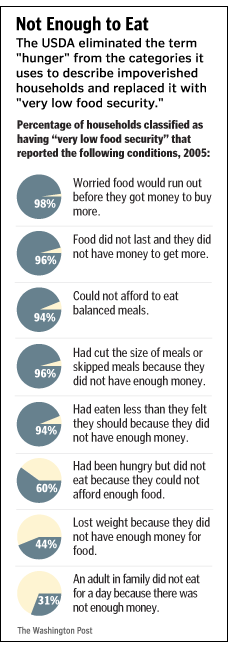
Whatever the intention, this linguistic airbrushing diminishes the shame of the problem, its persistence and its scope. That 11 million Americans reported going hun -- sorry, reported disrupted eating patterns -- is a national embarrassment. In this group, 96 percent said they cut the size of meals or skipped meals because they didn't have enough money. The same percentage said their food did not last and they did not have enough money to get more.
At least the USDA doesn't have jurisdiction over national monuments. Otherwise, just imagine it going after the inscription on the Statue of Liberty next: "Give me your energy-deficient, your financially challenged, your space-impaired masses yearning to breathe free."
Some Americans Lack Food, but USDA Won't Call Them Hungry
By Elizabeth Williamson
Washington Post Staff Writer
Thursday, November 16, 2006
The U.S. government has vowed that Americans will never be hungry again. But they may experience "very low food security."
Every year, the Agriculture Department issues a report that measures Americans' access to food, and it has consistently used the word "hunger" to describe those who can least afford to put food on the table. But not this year.
Mark Nord, the lead author of the report, said "hungry" is "not a scientifically accurate term for the specific phenomenon being measured in the food security survey." Nord, a USDA sociologist, said, "We don't have a measure of that condition."
The USDA said that 12 percent of Americans -- 35 million people -- could not put food on the table at least part of last year. Eleven million of them reported going hungry at times. Beginning this year, the USDA has determined "very low food security" to be a more scientifically palatable description for that group.
The United States has set a goal of reducing the proportion of food-insecure households to 6 percent or less by 2010, or half the 1995 level, but it is proving difficult. The number of hungriest Americans has risen over the past five years. Last year, the total share of food-insecure households stood at 11 percent.
Less vexing has been the effort to fix the way hunger is described. Three years ago, the USDA asked the Committee on National Statistics of the National Academies "to ensure that the measurement methods USDA uses to assess households' access -- or lack of access -- to adequate food and the language used to describe those conditions are conceptually and operationally sound."
Among several recommendations, the panel suggested that the USDA scrap the word hunger, which "should refer to a potential consequence of food insecurity that, because of prolonged, involuntary lack of food, results in discomfort, illness, weakness, or pain that goes beyond the usual uneasy sensation."
To measure hunger, the USDA determined, the government would have to ask individual people whether "lack of eating led to these more severe conditions," as opposed to asking who can afford to keep food in the house, Nord said.
It is not likely that USDA economists will tackle measuring individual hunger. "Hunger is clearly an important issue," Nord said. "But lacking a widespread consensus on what the word 'hunger' should refer to, it's difficult for research to shed meaningful light on it."
Anti-hunger advocates say the new words sugarcoat a national shame. "The proposal to remove the word 'hunger' from our official reports is a huge disservice to the millions of Americans who struggle daily to feed themselves and their families," said David Beckmann, president of Bread for the World, an anti-hunger advocacy group. "We . . . cannot hide the reality of hunger among our citizens."
In assembling its report, the USDA divides Americans into groups with "food security" and those with "food insecurity," who cannot always afford to keep food on the table. Under the old lexicon, that group -- 11 percent of American households last year -- was categorized into "food insecurity without hunger," meaning people who ate, though sometimes not well, and "food insecurity with hunger," for those who sometimes had no food.
That last group now forms the category "very low food security," described as experiencing "multiple indications of disrupted eating patterns and reduced food intake." Slightly better-off people who aren't always sure where their next meal is coming from are labeled "low food security."
That 35 million people in this wealthy nation feel insecure about their next meal can be hard to believe, even in the highest circles. In 1999, Texas Gov. George W. Bush, then running for president, said he thought the annual USDA report -- which consistently finds his home state one of the hungriest in the nation -- was fabricated.
"I'm sure there are some people in my state who are hungry," Bush said. "I don't believe 5 percent are hungry."
Bush said he believed that the statistics were aimed at his candidacy. "Yeah, I'm surprised a report floats out of Washington when I'm running a presidential campaign," he said.
The agency usually releases the report in the fall, for reasons that "have nothing to do with politics," Nord said.
This year, when the report failed to appear in October as it usually does, Democrats accused the Bush administration of delaying its release until after the midterm elections. Nord denied the contention, saying, "This is a schedule that was set several months ago."
In Second Coal Rush, New Mind-Set in the Mines
By Dale Russakoff, Washington Post Staff Writer
Thursday, November 16, 2006
COULTERVILLE, Ill. -- Billy Vandom was 220 feet underground, but to him, it was the top of the world. He is a coal miner, a species of well-paid American worker that was on the verge of extinction in these parts for more than a decade.
Now global economic forces have realigned, and coal mining is back. And a new generation of miners is living the good life not seen here since coal was king.
"I was able to buy me a new truck and I got my wife a new car," said Vandom, 22, from the helm of an enormous ram car, hauling tons of freshly mined coal through the low-lit darkness of the Gateway Mine here. "We have a new baby boy, and we moved into a new apartment and we fixed up a nice room for him."
Vandom has gone from struggling to pay bills with two low-wage jobs -- cooking at the Elks club and changing oil at the local Pennzoil -- to making $20 an hour plus benefits.
Those are union wages, but there is no union here. As the industry withered east of the Mississippi River, so did the United Mine Workers of America -- from 167,000 active members in 1980 to 16,000 today. The shift is profound in Southern Illinois, where being a miner used to begin with pledging allegiance to the UMWA for leading miners into the middle class.
Now the union is trying to come back, too, beginning with an organizing campaign targeting Peabody Energy Corp., owner of the Gateway Mine and the world's largest coal company.
It is proving to be a tough slog, and not just because the weakened union is up against a multibillion-dollar company. The UMWA is struggling to bridge a gap between young workers like Vandom, giddy over high wages in this long-depressed region, and older ones focused on pensions and gold-plated health care in retirement.
It is the same generational divide that defines the national debate over Social Security, but it is starker here because there is no one in the middle. As Midwestern coal production crashed in the 1980s and 1990s, young workers fled. People here refer to a "lost generation of miners." At Gateway, as at mines throughout the area, almost everyone is over 50 or under 30.
It falls to UMWA organizer Ron Huff to try to straddle the generation gap. He said he is making headway with middle-aged miners but very little with younger ones.
"All they can see is the money," he said. "I was the same way when I was their age.
"A Generation Gap"
The miners here come not only from different generations but different worlds. Those in their 50s mostly began mining as union men from union families, following grandfathers, fathers and uncles.
Their towns erected memorials to men who died in mine accidents alongside memorials for fallen soldiers. They relied on the union to protect them in a dangerous workplace and were raised to revere John L. Lewis, the longtime UMWA president.
"I have three pictures side by side in my house: John L. Lewis, Franklin Delano Roosevelt and Jesus," said Jack McReynolds, 70, a retired miner eating lunch recently at Lola's Uptown Restaurant in West Frankfort, once home to seven coal mines, all now closed. "I draw Social Security on account of FDR. I draw a pension on account of John L. Lewis, and I'm going to Heaven because of Jesus."
Minutes later, in walked an embodiment of the rupture in the union culture. Carl "Bubba" Vincelette, 27, another Gateway miner, was in grade school as mines closed and once-proud union men clamored to be janitors. His father never mined coal. "A lot of the young guys see all these places were union before and they all closed, so it's all part of what went wrong," he said.
If older miners say the union made them middle class, Vincelette credits Peabody, which he sees as a progressive firm that pays four times what he made at his previous job and invests heavily in safety and training. In two of the past three years, Peabody mines have won the Mine Safety and Health Administration's top award for safety.
Bobby Townsend, 46, one of the youngest union supporters at Wildcat Hills, a strip mine 80 miles southeast of here, sees Peabody very differently. He speaks with outrage about a company whose stock soared with energy prices and rewarded its departing chief executive with $46 million last year but won't pay for the health insurance of miners like him when they retire.
"It's out of balance between the corporate world and the workers, and we have to make a stand," he said. "We work ourselves to the bone and they go to a gym to get exercise. They look 50 when they're 70. We look 70 when we're 50. We spend our life making these people millions of dollars; we ought to at least have pension and medical.
"Not Quite Golden"
A dozen men in miners' boots filed into a meeting hall in Harrisburg, Ill., after their 10 1/2 -hour shift at Wildcat Hills. All had publicly pledged to support the UMWA, and all were over 50 but Townsend, his dark hair a striking exception among the gray and the bald.
"Nobody younger than me is up for the union," Townsend said. "They're buying houses and motorcycles. They think it'll run forever."
"It won't," said Larry Robbins, a miner for 26 years. His last union mine closed in the 1990s, three months before he would have logged a golden 20 years -- golden because that's when union miners qualify for lifetime retiree health insurance. Every year worked in a UMWA mine counts toward the 20. Time in a nonunion mine does not.
Around the room, one after another miner said he needed only a year or two or three of union time to hit the 20-year mark. All had voted as young men to limit wage increases in favor of retiree benefits -- only to see the clock stop before their time came.
Gary Wheeler, 53, had 17 years when his mine closed in 1994. Danny Droit, 59, said he had "roughly" 20, but worried that his total time would fall just short of the mark. Dick Bearden had 17 years.
"That medical card is worth its weight in gold," Townsend said. "My father-in-law retired with it, and he didn't have to worry what the doctor or the medicine cost. My father is in construction and is still working at age 76 to pay for health insurance."
The former union miners were among thousands east of the Mississippi River whose mines closed after Congress mandated acid rain controls in 1990, shattering demand for high-sulfur coal. To comply, utilities switched en masse to low-sulfur coal from the vast Powder River Basin in Montana and Wyoming.
The shift effectively broke the union. Mines closed or went bankrupt across the Midwest and northern Appalachia, where the union was dominant, and opened throughout the nonunion West.
Court rulings hastened the union's decline. Gateway, for example, was for decades a union mine doing business as Zeigler 11. But its previous owner won the right in bankruptcy court to shed its union contracts in 2004. Peabody bought the mine out of bankruptcy, changed its name and reopened it in 2005 under a nonunion subsidiary, Black Beauty Coal Co.
Eighty percent of Peabody's miners were unionized in the 1980s. With its operations now mostly in the West, chief executive Gregory Boyce reported this year to shareholders that 85 percent of Peabody's coal comes from "union-free operations.
''I Just Want the Cash Now''
Coal's rebound here is a direct result of soaring U.S. demand for electricity, half of which currently comes from coal. The Bush administration is promoting coal as a "freedom fuel" -- in contrast to foreign oil -- and utilities are on a coal binge, with 154 new coal-fired plants on the drawing board. New plants must have scrubbers that remove sulfur before it reaches the atmosphere, so high-sulfur coal is back in the game. Meanwhile, coal states and the industry are investing heavily in technologies to convert coal into liquid fuel to power cars and jet planes.
The Illinois Office of Coal Development forecasts 3,000 new mining jobs statewide in the next three years, and another 2,000 as older miners retire, but that is just a shadow of the roughly 20,000 coal mining jobs that were here before the crash. And other high-paying production jobs are vanishing; a nearby Maytag plant with 942 workers is closing next month.
Younger workers interviewed throughout the area said they felt they had little leverage to complain about long hours or difficult working conditions because so many people were waiting in line for jobs that pay well. Gateway had 1,300 applicants for its 200 jobs, according to operations manager Thomas A. Benner.
Aaron Wright, 37, a son and nephew of union miners, said he would happily work without a union if he could get a coal-mining job.
"I'm tired of making $8 to $9 an hour, not enough to support myself, not enough to support my kids," Wright said. "I just want the cash now."
Middle-aged union supporters say younger workers are naive to think they won't face supervisors who underestimate danger or play favorites in assigning work, or try to deny their rights if they are injured or lay them off without explanation. They say they've seen all this and more.
But Vic Svec, Peabody's senior vice president for communications, said the company works hard to show workers they don't need a union. Peabody pegs its wage scale to match or exceed the UMWA's, he said. It also provides a 401(k) with a generous company match, and pays bonuses at mines that meet productivity and safety targets. Vandom said he gets a $700 to $800 bonus about every three months.
"Our strategy is to have the best possible relationship with employees," Svec said. "We don't feel it benefits our employees or our operations to have third parties involved."Thinking Long Term
With so many miners nearing retirement age, Peabody also has a major financial interest in keeping the union at bay: Retired miners have much higher than average medical costs, according to a union study.
This was easy to believe from the collective ailments of UMWA pensioners who gathered on a recent morning at the Knights of Columbus hall in Pinckneyville. Robert McCrary, 72, who retired from Arch Coal Inc. after 36 years, said he has black lung disease, and heart disease that has required multiple stents, a defibrillator and a pacemaker. He said he takes 16 prescription drugs.
Larry Bruns, 63, who retired from Peabody after more than 37 years, said he has had hip replacements, a hernia, carpal tunnel syndrome, arthritis, high blood pressure and an enlarged prostate -- "and I'm just a young pup."
With so few active union miners, many retirees say they worry the UMWA will have trouble defending their increasingly costly health care at the bargaining table. Retiree medical care is negotiated in each union contract.
"If they take the insurance away, they'll just need enough to bury me," said Rick Harrison, another Zeigler retiree, who has had three open-heart surgeries and is due for a fourth.
Back at Lola's Uptown Restaurant, Vincelette recalled that he had listened with an open mind when a UMWA organizer visited him recently. The organizer said union coal miners elect safety committees that have authority to shut a mine if they judge it unsafe. But Vincelette said he trusted Peabody to be vigilant about safety.
The organizer also said that with 20 years in a union mine, Vincelette would get retiree health insurance for life. But 20 years sounded like an eternity.
"The way everything's going -- wars and stuff like that -- it's hard to think long term," he said.
McReynolds, the retired UMWA miner with John L. Lewis's picture in his living room, listened from across the table in pained silence.
When the young miner left, McReynolds rose slowly from his chair and straightened his Mason's hat bearing a UMWA pensioners' emblem and a gold pick-and-shovel pin the union gave him. "That young man has no idea what he's talking about," he said.