Sunday, November 16, 2008

LALGARH NEWS

Maoists threaten Lalgarh war
The Telegraph CORRESPONDENT

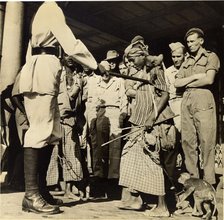
Midnapore, Nov. 12: Maoists today threatened an armed resistance in West Midnapore’s Lalgarh where tribals have been protesting police raids and detentions following a blast that missed the chief minister by minutes.

CPI (Maoist) state secretary Kanchan said: “We are with the people of Lalgarh. Our guerrilla squad is with them to build an armed resistance. I appeal to the Lalgarh people to follow the Nandigram path by setting up road blocks and snapping electricity and telephone connections to teach the CPM and police a lesson.”

Villagers armed with bows and arrows tonight placed at least 30 trees at various points on the road that branches off NH 6 and leads to Jhargram town. They also blocked the road connecting Jhargram with Jamboni. “They are trying to cut off the town,” a police officer said.

The road to Jhargram from Midnapore town had not been touched till late tonight.

In East Midnapore’s Nandigram, villagers led by the Trinamul Congress and all- egedly aided by Maoists had created a similar island of unrest, cut-off from the administration.

In Jhargram, the villagers wrote on the road: “The police have to explain why innocent villagers were arrested on suspicion of being Maoists.”

Tribal youths continued to obstruct the state highway connecting Midnapore town with Bandwan in Purulia.

“The Maoists have been instigating the villagers. We have got some vital information after questioning three persons picked up from Binpur and Jamboni on November 6,” said West Midnapore police chief R.K. Singh. He declined comment when asked why the intelligence branch had failed to tip off the administration about Maoist activities.

Armed policemen had pounced on schoolchildren returning from a soiree and tried to link them with the rebels while probing the blast at Salboni that hit a car in Union minister Ram Vilas Paswan’s convoy on November 2. Women were allegedly beaten up during the raids that followed.

District magistrate N.S. Nigam said the allegations of police misconduct would be probed. “I appeal to the agitating villagers to return home and let us redress their grievances through talks,” he said.

Detentions by ‘mistake’ that made Lalgarh dig up roads
PRONAB MONDAL

Lalgarh (West Midnapore), Nov. 11: Headmaster Asim Ganguly woke up on November 4 morning to hear two of his Class VIII students had been arrested in connection with the Maoist blast two days earlier. He couldn’t believe his ears.

“They are normal, innocent boys who wouldn’t dream of doing anything subversive,” the head of Vivekananda Vidyapith in Kanthapahari, Lalgarh, said today. “The police action was absurd, cruel and high-handed.”

The arrest of the two 14-year-olds and a friend — and police raids that led to women being beaten up — were the main reason Lalgarh’s villagers have dug up roads, Nandigram style, to keep the administration at bay.

Buddhadeb Patra and Goutam Patra were picked up with Aben Murmu — a 15-year-old Class VIII student from Ramakrishna High School — on November 3 night on suspicion of links with the Maoists who had tried to bomb the chief minister’s car the day before.

All three were freed on bail four days later but Ganguly hasn’t yet recovered from the shock. “Why didn’t the police get in touch with me first? I’ve taught these boys and watched over them for so many years now — wouldn’t I know what sort they were?”

Perhaps to give their action a semblance of credibility, the police had initially bloated the ages of the boys by four years each to 18, 18 and 19. However, the man they dragged out of bed at 3 the next morning in Barapelia village was 62.

Retired teacher Khamananda Mahato, who used to teach at Ganguly’s school, said: “Some 200 armed policemen surrounded my house, their faces covered with black cloth. They ordered me to accompany them.”

Mahato’s wife was ill and he requested them to wait till morning, but they would not agree. At Lalgarh police station, he was asked to identify a man he had never seen, and was held till 4pm. Mahato today said he was still “traumatised”.

“Mastermoshai was a very popular teacher. It’s absurd to link him to any anti-national activity,” Ganguly, 40, said of his former colleague.

District police chief Rajesh Kumar Singh admitted the arrests and the detention were “mistakes”. He said: “We had no evidence and so did not oppose the boys’ bail plea. We also dropped their names from the chargesheet.”

Mahato, Singh added, “lives in an area that is a Maoist corridor; so we thought he might know some of the suspects. Later we realised that he didn’t.”

The boys said they were returning from a baul performance at Kanthapahari, 4km from their home in Banshber, around 11pm when armed policemen pounced on them.

“They threw me by the collar inside a van, flat on the floor, my face shoved between their boots. Not a single question was asked, not who we were, or where we were from,” Aben said.

Within minutes, Goutam and Buddhadeb too were flung inside the van and, like Aben, lay prone on the floor.

“I was so frightened, I started crying,” Goutam said. “A policeman prodded me with his boot and shouted he would kick me to death unless I stopped. I tried to smother my sobs and then the van started moving.”

At Salboni police station, when the boys were repeatedly asked to name their dadas (Maoist seniors), one of them, clueless about what they were being asked, replied he didn’t have a dada (elder brother).

“The police slapped us and beat us but they got nothing out of us because we didn’t know anything,” Buddhadeb said.

After some time, they were pushed into the lock-up. “One night here, and you’ll be talking tomorrow,” a policeman said.

The boys were charged with waging war against the country, causing hurt with dangerous weapons and attempt to murder.

“How could the police think my son would do any such thing?” wept Pratima Patra, Goutam’s mother, at her mud hut. “I went to Lalgarh and fell at officers’ feet but they wouldn’t listen.”

The boys were released only when village after village erupted in protest. The agitators today dug up a road in Salboni and continued blocking the Midnapore-Bandwan highway despite a promise yesterday to repair it.

In Lalgarh, CPM leaders run for guns

Indian Express

Kolkata, November 14 : When it comes to political leaders moving with a gun-toting entourage, there is little difference these days between Western Uttar Pradesh and the Maoist-affected areas of West Midnapore.
During its trip to Lalgarh, several encounters of The Indian Express with the zonal leaders of the CPM proved that panic has struck the party hard ever since the tribal agitation began on November 5.

Those blessed with clout are granted security personnel from the state’s armed forces. The officials in the district administration confided that over 100 grassroots leaders now move with private protectors. The threat perception is said to be “real” from Maoists, who have strong pockets of influence in the region.

On way to Lalgarh, at Bottola Chalk near the local CPM party office, The Indian Express met Anuj Pande, the party’s zonal committee secretary. Moving around with gun-totting securitymen provided by the government, Pande still looks a scared man.

World Leaders Vow Joint Push to Aid Economy


MARK LANDLER
NYT, November 16, 2008

WASHINGTON — Facing the gravest economic crisis in decades, the leaders of 20 countries agreed Saturday to work together to revive their economies, but they put off thornier decisions about how to overhaul financial regulations until next year, providing a serious early challenge for the Obama administration.

Though the countries’ stimulus packages were cast as ambitious steps, they mainly reflected measures that the countries were already undertaking to respond to the crisis. What remains to be seen is whether, working with a new White House, the leaders will cast aside their political and economic differences to embrace more radical changes, including far-reaching but fiercely debated proposals to overhaul regulation.

The group planned its next meeting for April 30, 101 days after President-elect Barack Obama is sworn into office.

Mr. Obama, who sent emissaries but did not attend at the meeting, will find common ground with the leaders in his support of a further stimulus program in the United States — something President Bush opposes. The group called for more fiscal measures to cushion the blow of a downturn that is hitting rich and poor countries.

Two senior advisers for Mr. Obama, Madeleine K. Albright and James A. Leach, met privately with leaders on the sidelines. And Mr. Obama addressed the meeting only obliquely on Saturday in his first radio address as president-elect, in which he expressed appreciation that Mr. Bush “has initiated this process, because our global economic crisis requires a coordinated global response.”

Meeting here, in the capital of the country where the crisis began, the extraordinary gathering of leaders from the Group of 20, representing wealthy countries and major emerging economies, began what participants said would be a broad reform of the institutions that have governed global markets since World War II.

In a five-page communiqué that mixed general principles with specific steps, the G-20 pledged a new effort to bolster supervision of banks and credit-rating agencies, scrutinize executive pay and tighten controls on complex derivatives, which deepened the recent market turmoil.

“Our nations agree that we must make the financial markets more transparent and accountable,” President Bush said. He warned that “a meeting is not going to solve the world’s problems,” and described the talks as the beginning of a process that would carry over to the next administration.

With dueling press briefings and statements through the weekend, it was clear that bridging ideological gaps among nations afflicted with different versions of the economic contagion would provide the new president and other world leaders with a daunting challenge.

There is also a more basic philosophical divide across the Atlantic: Europeans in general favor more state control over markets, even to the point of granting regulators cross-border authority, while the United States stresses the primacy of national regulators. President Nicolas Sarkozy of France, who called on Mr. Bush to organize the meeting, alluded to those differences, saying the negotiations, even on general principles, had been challenging.

Mr. Sarkozy said: “I am a friend of the United States of America, but if you ask, was it easy? No, it wasn’t easy.” He added that he did not fly to Washington “simply for the pleasure of traveling.”

He said the Americans had made concessions even by agreeing to discuss issues like regulatory coordination and executive pay. The communiqué, however, suggested there were concessions on both sides.

Prodded by Mr. Bush, who earlier in the week gave an impassioned defense of capitalism, the leaders reaffirmed their commitment to free markets and trade. But they also clearly laid blame for the crisis at the doorstep of the United States, saying “some advanced countries” had taken inadequate steps to prevent a buildup of dangerous risks.

The meeting set out a road map for overhauling regulations in a wide range of areas, and assigned the work to groups of experts. At the next meeting, which Mr. Sarkozy proposed to hold in London, the leaders will debate specific proposals developed by those groups.

Among those measures is a European proposal to set up so-called colleges of supervisors, which would meet regularly to share information about global banks with operations in many countries.

Another idea is to expand the membership of the Financial Stability Forum, an influential group of finance ministers and central bankers from industrialized countries, to include emerging markets like Brazil and China.

Still, for all the talk of action and history-making change, some experts said the outcome was disappointing.

“This is plain-vanilla stuff they could have agreed on without holding a meeting,” said Simon Johnson, an economist at the Massachusetts Institute of Technology and a former chief economist of the International Monetary Fund. “What’s new, except that this is the G-20 instead of the G-7?”

Despite broad support for economic stimulus, the leaders were not able to agree on a coordinated global effort. The Bush administration, which does not favor a further stimulus, resisted that idea. And the proposal for colleges of supervisors fell short of an international regulatory agency favored by the French. The Bush administration opposes any regulatory agency with cross-border authority.

The statement did not single out hedge funds as needing regulation, which Germany has long advocated. German diplomats said they were satisfied that the issue would be addressed later. “There shall be no blind spots,” said the German chancellor, Angela Merkel.

Despite playing up the role of the International Monetary Fund as a vehicle for helping developing countries in crisis, the leaders did not call for an expansion in the fund’s lending resources.

Collectively, the leaders here represented countries that account for 85 percent of the world’s economy. But the guest list was more remarkable for what it said about the shifting landscape of power. With the United States and Europe struggling economically and consumed by efforts to stabilize their banks, China, Japan and Saudi Arabia emerged as the likeliest candidates to help distressed countries.

In one of the few concrete commitments, the Japanese prime minister, Taro Aso, pledged to increase lending to the I.M.F. by up to $100 billion, and he encouraged other cash-rich countries to do the same. On Saturday, the fund added Pakistan to its list of countries receiving emergency funds. Pakistan said it had agreed to a loan of $7.6 billion to prevent a default by its government.

Some leaders were simply eager to be heard. “Emerging market countries were not the cause of this crisis, but they are amongst its most affected victims,” the prime minister of India, Manmohan Singh, said.

The leaders convened in the colonnaded great hall of the National Building Museum, a 19th-century building that served as headquarters for the United States Pension Fund after the Civil War. It was also the place Senator Hillary Rodham Clinton used to end her presidential campaign last June.

Mr. Bush, accompanied by his Treasury secretary, Henry M. Paulson Jr., sat between Brazil’s president, Luiz Inácio Lula da Silva, who chairs the Group of 20, and Prime Minister Aso.

Afterward, Mr. Bush acknowledged that expanding the group from the customary seven or eight industrialized powers to 20 nations raised the risk that nothing substantive would get done.

But Mr. Bush said the meeting had been surprisingly substantive, and he seemed enthusiastic about one of the more arcane proposals: a clearinghouse for the $33 trillion market in credit default swaps.

These derivatives, which act as a form of insurance against the failure of an underlying asset, have been blamed for exacerbating the recent market upheaval. A clearinghouse would back trades in credit default swaps and absorb losses if a dealer in these securities failed.

Mr. Bush said he felt compelled to act because “if you don’t take decisive measures, then it’s conceivable that our country could go into a depression greater than the Great Depressions.”

When Mr. Sarkozy first proposed the meeting, some predicted it would be dominated by finger-pointing. Now, some critics said the communiqué did not go far enough in assigning blame for the crisis.

“Anyone looking for the G-20 to issue a mea culpa on the global financial crisis will be sadly disappointed,” said Kenneth S. Rogoff, a professor of economics at Harvard. The leaders “curiously downplay the huge culpability of the political leadership in the U.S. and Europe.”

With Mr. Bush’s imminent departure, however, there seemed to be little appetite to pile on the United States.

With Congress likely to consider a stimulus package in the coming weeks or in January, Mr. Johnson of M.I.T. said Mr. Obama might be able to go to the next summit meeting with strong evidence of American action.

“The U.S., despite having broken all the china, may end up playing a decisive role in fixing this situation,” he said.

Steven Lee Myers, David D. Kirkpatrick and Sheryl Gay Stolberg contributed reporting.

Friday, November 14, 2008

Withdraw police cases against BESU students

To: Governor, West Bengal, INDIA
To
The Chancellor, Bengal Engineering & Science university &
The Hon’ble Governor of West Bengal .

Sir,

We are watching the affairs of the BESU institution with concern and regret. A premier institution, 150-year old, turning out young builders of the country is being destroyed for petty partisan interests. Taking advantage of a scuffle between two sections of students, a matter which the departmental teachers had themselves almost settled, the VC called the police and closed the institution sine die from 6.11.08. The police arrested eleven students from the campus . Teachers were individually insulted by top police officers.

The police brought bailable charges against three students belonging to the students' wing of the major ruling party, and they were released on P.R.Bond on the same day. But non-bailable charges, although false and even, perhaps, laughable, were brought against eight students without such affiliation, and they spent four nights in jail.. This act of the police exemplifies how the police and the administration carry out abjectly the orders of the major ruling party.

Surprisingly enough , BESU Board of Management in its meeting on 13.11.08 resolved that

1) Henceforth the Law and Order problem of BESU will be handled by the police

2) A new code of conduct of the students will be enforced which ought to be signed by the students and their guardians, in spite of the fact that there exists a code of conduct;

3) A code of conduct for the teachers will also be enforced.

In the present instance there are two major partisan interests:

(i)
Students are being shown just before the union elections the extent to which the college administration and the police are prepared to go in victimising those who refuse to support the major ruling party's students' wing.

(ii) The elevation of BESU to IIEST status is sought to be prevented to continue the state government's stranglehold over the BESU.

In the circumstances we appeal to you to ensure
(a) the withdrawal of all charges against students
(b) the withdrawal of police from the campus
(c) the withdrawal of draconian decisions of the Board of Management unprecedented for any educational institution
(d) security for students through internal measures
(e) redressal of the grievances of the students, and
(f) initiation of a discussion with the students, teachers, alumni and guardians to restore normalcy in the Institute.


Sincerely,

The Undersigned
click here to sign petition

Saturday, November 08, 2008

Studs Terkel’s Legacy: A Vivid Window on the Great Depression

ADAM COHEN
NYT, November 8, 2008

After the great crash of 1929, the Wells-Grand Hotel in Chicago began losing guests. The ones who remained had more time for idle pastimes. “The decks of cards were wearing out more quickly” and “the black and red squares of the checkerboard were becoming indistinguishable.”

Those are the recollections of Studs Terkel, from his classic oral history of the Great Depression, “Hard Times.” I found myself re-reading the book this week because of the confluence of two unhappy events: the economic downturn and the death of Mr. Terkel on Oct. 31. He was 96.

I knew Mr. Terkel a bit — enough to appreciate his gentle nature, his deep interest in people of all sorts and his drive to reform the world. As I turned the pages of “Hard Times,” I was struck by the remarkable fit between historian and subject.

In Mr. Terkel’s wide-ranging interviews, the horrors of the Depression come through vividly. A manual laborer on the San Francisco waterfront recalled that when a sugar refinery offered four jobs to a crowd massed at the gates, “a thousand men would fight like a pack of Alaskan dogs” over them.

Dorothy Day, the Catholic social activist, told Mr. Terkel that in 1933 and 1934, “there were so many evictions on the East Side, you couldn’t walk down the streets without seeing furniture on the sidewalk.” An African-American hobo, Louis Banks, said that when he rode on top of boxcars, there was a railroad policeman who wouldn’t ask him to get off the train; he would just shoot.

Rich people also suffered in the Depression, and though they generally had more resources to fall back on, Mr. Terkel documented their woes with the same care he devoted to the hardest hit. Diana Morgan, a young woman from a wealthy Southern family, spoke of returning home from college and finding no cook or cleaning woman. The telephone had been disconnected. “And this was when I realized that the world was falling apart,” Ms. Morgan said.

Mr. Terkel noted the heavy psychological toll the Depression took on Americans. “The suddenly idle hands blamed themselves, rather than society,” he recalled. “No matter that others suffered the same fate, the inner voice whispered, ‘I’m a failure.’ ”

Radicalism swept the land, several of Mr. Terkel’s interview subjects recalled. “People were talkin’ revolution all over the place,” Joe Morrison, a steel worker, said. “You met guys ridin’ the freight trains and so forth, talkin’ about what they’d like to do with a machine gun.” In the Farm Belt, farmers frequently resorted to violence, including the near-lynching of an Iowa judge considered too willing to grant foreclosures.

Mr. Terkel, who worked for the Work Progress Administration’s Federal Writers’ Project, was highly sympathetic to the New Deal. The book contains a whole section of New Dealers reminiscing, including the economist Joe Marcus, who recalled the satisfaction of being part of Roosevelt’s crusade. “Laws could be changed,” Mr. Marcus said. “So could the conditions of people.”

Jane Yoder of Evanston, Ill., told Mr. Terkel how miraculous it was when her father, an unemployed blacksmith, found a W.P.A. job. “This was a godsend,” she said. “It meant food, you know. Survival, just survival.”

“Hard Times” does not romanticize the Depression, but at least a few of Mr. Terkel’s subjects managed to find silver linings. E.Y. Harburg was a young businessman whose company went bust after the crash. His friend Ira Gershwin told him to get a pencil and a rhyming dictionary and get to work. “When I lost my possessions, I found my creativity,” Mr. Harburg said. “I felt I was being born for the first time.”

He later wrote “Brother, Can You Spare a Dime?,” the Depression victim’s anthem, and the lyrics to songs in “The Wizard of Oz.”

“Hard Times” ends with an interview with Virginia Durr, a grand old Alabama woman I knew years ago when I lived in the state. Mrs. Durr, who fought the poll tax and bailed out Rosa Parks when she was arrested before the Montgomery Bus Boycott, was raised in genteel, sheltered circumstances. The Depression transported her.

“It was the first time I had seen the other side of the tracks,” Mrs. Durr told her good friend Mr. Terkel. “The rickets, the pellagra — it shook me up. I saw the world as it really was.”

She seems to have been speaking for Mr. Terkel, who also came of age in the 1930s. His lifelong empathy for the disenfranchised was rooted in the troubled era recalled so vividly in “Hard Times.”

The Obama Agenda

PAUL KRUGMAN
NYT, November 7, 2008

Tuesday, Nov. 4, 2008, is a date that will live in fame (the opposite of infamy) forever. If the election of our first African-American president didn’t stir you, if it didn’t leave you teary-eyed and proud of your country, there’s something wrong with you.

But will the election also mark a turning point in the actual substance of policy? Can Barack Obama really usher in a new era of progressive policies? Yes, he can.

Right now, many commentators are urging Mr. Obama to think small. Some make the case on political grounds: America, they say, is still a conservative country, and voters will punish Democrats if they move to the left. Others say that the financial and economic crisis leaves no room for action on, say, health care reform.

Let’s hope that Mr. Obama has the good sense to ignore this advice.

About the political argument: Anyone who doubts that we’ve had a major political realignment should look at what’s happened to Congress. After the 2004 election, there were many declarations that we’d entered a long-term, perhaps permanent era of Republican dominance. Since then, Democrats have won back-to-back victories, picking up at least 12 Senate seats and more than 50 House seats. They now have bigger majorities in both houses than the G.O.P. ever achieved in its 12-year reign.

Bear in mind, also, that this year’s presidential election was a clear referendum on political philosophies — and the progressive philosophy won.

Maybe the best way to highlight the importance of that fact is to contrast this year’s campaign with what happened four years ago. In 2004, President Bush concealed his real agenda. He basically ran as the nation’s defender against gay married terrorists, leaving even his supporters nonplussed when he announced, soon after the election was over, that his first priority was Social Security privatization. That wasn’t what people thought they had been voting for, and the privatization campaign quickly devolved from juggernaut to farce.

This year, however, Mr. Obama ran on a platform of guaranteed health care and tax breaks for the middle class, paid for with higher taxes on the affluent. John McCain denounced his opponent as a socialist and a “redistributor,” but America voted for him anyway. That’s a real mandate.

What about the argument that the economic crisis will make a progressive agenda unaffordable?

Well, there’s no question that fighting the crisis will cost a lot of money. Rescuing the financial system will probably require large outlays beyond the funds already disbursed. And on top of that, we badly need a program of increased government spending to support output and employment. Could next year’s federal budget deficit reach $1 trillion? Yes.

But standard textbook economics says that it’s O.K., in fact appropriate, to run temporary deficits in the face of a depressed economy. Meanwhile, one or two years of red ink, while it would add modestly to future federal interest expenses, shouldn’t stand in the way of a health care plan that, even if quickly enacted into law, probably wouldn’t take effect until 2011.

Beyond that, the response to the economic crisis is, in itself, a chance to advance the progressive agenda.

Now, the Obama administration shouldn’t emulate the Bush administration’s habit of turning anything and everything into an argument for its preferred policies. (Recession? The economy needs help — let’s cut taxes on rich people! Recovery? Tax cuts for rich people work — let’s do some more!)

But it would be fair for the new administration to point out how conservative ideology, the belief that greed is always good, helped create this crisis. What F.D.R. said in his second inaugural address — “We have always known that heedless self-interest was bad morals; we know now that it is bad economics” — has never rung truer.

And right now happens to be one of those times when the converse is also true, and good morals are good economics. Helping the neediest in a time of crisis, through expanded health and unemployment benefits, is the morally right thing to do; it’s also a far more effective form of economic stimulus than cutting the capital gains tax. Providing aid to beleaguered state and local governments, so that they can sustain essential public services, is important for those who depend on those services; it’s also a way to avoid job losses and limit the depth of the economy’s slump.

So a serious progressive agenda — call it a new New Deal — isn’t just economically possible, it’s exactly what the economy needs.

The bottom line, then, is that Barack Obama shouldn’t listen to the people trying to scare him into being a do-nothing president. He has the political mandate; he has good economics on his side. You might say that the only thing he has to fear is fear itself.

Change I Can Believe In

DAVID BROOKS
NYT, November 7, 2008

I have dreams. I may seem like a boring pundit whose most exotic fantasies involve G.A.O. reports, but deep down, I have dreams. And right now I’m dreaming of the successful presidency this country needs. I’m dreaming of an administration led by Barack Obama, but which stretches beyond the normal Democratic base. It makes time for moderate voters, suburban voters, rural voters and even people who voted for the other guy.

The administration of my dreams understands where the country is today. Its members know that, as Andrew Kohut of the Pew Research Center put it on “The NewsHour,” “This was an election where the middle asserted itself.” There was “no sign” of a “movement to the left.”

Only 17 percent of Americans trust the government to do the right thing most or all of the time, according to an October New York Times/CBS News poll. So the members of my dream Obama administration understand that they cannot impose an ideological program the country does not accept. New presidents in 1932 and 1964 could presuppose a basic level of trust in government. But today, as Bill Galston of the Brookings Institution observes, the new president is going to have to build that trust deliberately and step by step.

Walking into the Obama White House of my dreams will be like walking into the Gates Foundation. The people there will be ostentatiously pragmatic and data-driven. They’ll hunt good ideas like venture capitalists. They’ll have no faith in all-powerful bureaucrats issuing edicts from the center. Instead, they’ll use that language of decentralized networks, bottom-up reform and scalable innovation.

They will actually believe in that stuff Obama says about postpartisan politics. That means there won’t just be a few token liberal Republicans in marginal jobs. There will be people like Robert Gates at Defense and Ray LaHood, Stuart Butler, Diane Ravitch, Douglas Holtz-Eakin and Jim Talent at other important jobs.

The Obama administration of my dreams will insist that Congressional Democrats reinstate bipartisan conference committees. They’ll invite G.O.P. leaders to the White House for real meetings and then re-invite them, even if they give hostile press conferences on the White House driveway.

They’ll do things conservatives disagree with, but they’ll also show that they’re not toadies of the liberal interest groups. They’ll insist on merit pay and preserving No Child Left Behind’s accountability standards, no matter what the teachers’ unions say. They’ll postpone contentious fights on things like card check legislation.

Most of all, they’ll take significant action on the problems facing the country without causing a mass freak-out among voters to the right of Nancy Pelosi.

They’ll do this by explaining to the American people that there are two stages to their domestic policy thinking, the short-term and the long-term.

The short-term strategy will have two goals: to mitigate the pain of the recession and the change the culture of Washington. The first step will be to complete the round of stimulus packages that are sure to come.

Then they’ll take up two ideas that already have bipartisan support: middle-class tax relief and an energy package. The current economic and energy crisis is an opportunity to do what was not done in similar circumstances in 1974 — transform this country’s energy supply. A comprehensive bill — encompassing everything from off-shore drilling to green technologies — would stimulate the economy and nurture new political coalitions.

When the recession shows signs of bottoming out, then my dream administration would begin phase two. The long-term strategy would be about restoring fiscal balances and reforming fundamental institutions.

By this time, the budget deficit could be zooming past $1.5 trillion a year. The U.S. will be borrowing oceans of money from abroad. My dream administration will show that it understands that the remedy for a culture of debt is not more long-term debt. It will side with those who worry that long-term deficits could lead to ruinous interest-rate hikes.

My dream administration will announce a Budget Rebalancing Initiative. Somebody like Representative Jim Cooper would go through the budget and take out the programs and tax expenditures that don’t work. “If we have no spending cuts, then we’re saying government is perfect. Nobody believes that,” Cooper says.

Having built bipartisan relationships, having shown some fiscal toughness, having seen the economy through the tough times, my dream administration will then be in a position to take up health care reform, tax reform, education reform and a long-range infrastructure initiative. These reforms may have to start slow and on the cheap. But real reform would be imaginable since politics as we know it would be transformed.

Is it all just a dream? I hope not. In any case, please be quiet and let me have my moment.

An Eternal Revolution

By ORLANDO PATTERSON
NYT, November 7, 2008

BARACK OBAMA’S victory marks the end of another magnificent chapter in America’s experience of democracy. But rather than being seen as a radical transition, it is best viewed as part of an ever-evolving process that began with the election of George Washington in 1789. To interpret it as a foundational change, ushering something new and unknown, is to diminish the past, to unduly singularize Mr. Obama’s achievement and to raise unrealistic expectations about his presidency.

Mr. Obama owes his victory, first, to his gift of leadership and personality: the hybrid cool of his charisma, his cathartic power to mine unity from difference. But his triumph depended on voters, first prone to see his candidacy as exotic, to recognize it as something that could (and would) only happen here. That they did stems in large part from the founding fathers’ clear vision of the ideal makeup of a democracy: an inclusive electorate, political participation and political power sharing.

This was a vision that terrified as much as it fascinated the conservative men who were often amazed at what they had signed on to in 1787: a revolutionary “charter of power granted by liberty,” in James Madison’s nervously triumphalist prose. So they promptly ensured that it would only very slowly threaten the political hegemony of older white men.

Three groups, in particular, were excluded from the process: blacks, women and the young. The history of American democracy can be read in good part as the struggle of all three to become fully included in the process. The 2008 campaign was remarkable in the way all three groups worked together to realize, finally and fully, the ambivalent vision of the founders.

Most important to the Obama victory was the long struggle of black Americans to be incorporated in the public sphere. That entailed not just the dismantlement of Jim Crow but the election of black officers at all levels of the political system. The sheer presence of significant numbers of blacks in positions of political authority was as much the cause as the consequence of the profound change in white political attitudes. Colin Powell’s flirtation with a presidential run was a critical point in this shift in white attitude, effectively priming the nation for the possibility of a black candidate. But so too were the appointments of blacks such as Secretary of State Condoleezza Rice and former Commerce Secretary Ron Brown.

And while disdained by most social scientists, the cultural dimension of black public incorporation also prepared the way: a white population that venerates Will Smith, Oprah Winfrey and Michael Jordan, its youth steeped in hip-hop, has already gone a long way toward accepting a black leader in the highest office of the public sphere, even if whites are reluctant to do the same in their segregated private lives.

Of equal importance in explaining Senator Obama’s triumph, however, are American women. This campaign was, in a remarkable way, a condensed re-enactment of the entire intertwined struggle of blacks and women for political inclusion. White women first rejected their confinement to the role of virtuous motherhood in the private sphere of the early Republic by championing the very public struggle for the abolition of slavery. In much the same way, the modern second wave of feminism was facilitated by, and partly modeled on the black civil rights movement.

Black achievement has always presaged female advancement, not always from the noblest of motives: if blacks could vote, enjoy protection from discrimination and run for office, so should women. Hillary Clinton’s forceful campaign, however important, pales in comparison with this historic American tendency in explaining why a female president is now a near certainty and not long off.

But women have always repaid the debt. A quiet but momentous change took place in the 1980s that was just as important as the civil rights movement in explaining Barack Obama’s victory: the epochal shift in the voting behavior of women who, for the first time since enfranchisement, voted in greater numbers, and more progressively, than men. In raw demographic terms, the most important factor in explaining the Obama victory was women voting by a 13 percent margin in his favor, while men were almost evenly split. President Obama would neglect this base of support at his peril.

Finally, there is the much discussed resurgence in the youth vote. Here, again, change is best viewed as a critical moment in a pre-existing process. American youths have long voted at distressingly low levels, although the turnout of eligible voters between 18 and 29 surged moderately between 2000 and 2004, from 36 to 47 percent. While Tuesday’s exit polls are showing only an incremental change in this rate, Mr. Obama had a powerful impact on youth activism, deploying young Americans in voter mobilization ground operations and in the game-changing use of the Internet for voter outreach and campaign finance.

Young voters went 2-to-1 in Mr. Obama’s favor on Tuesday. Their advocacy in the Iowa caucuses was likely the decisive factor in his all-important victory there. The most lasting effect of all this may be a permanent shift of the youth vote toward the Democratic Party, although one can certainly expect the Republicans, who made successful efforts on campuses in the Ronald Reagan years, to mount a challenge.It appears, too, that the intense bonding of younger Americans with the youthful Mr. Obama initiates the transmission of power from baby boomers, who have for so long consumed the nation’s assets and attention, to a younger generation from whom so much has already been taken, in social security and resources.

To view the election of Barack Obama as notable only as an example of breaking through a racial barrier is to misunderstand the greater flow of our ever-more-inclusive democracy. America has, at last, delivered, in creating the most sublime example of democratic governance since its invention in Greece 25 centuries ago.

Orlando Patterson is a professor of sociology at Harvard and the author of “The Ordeal of Integration.”

Friday, November 07, 2008

BESU

Dear Friends,

The Bengal Engineering College, now a university, the BESU, has been closed sine die by its VC on November 6, after he called in the police to punish a section of the students who do not follow the dictates of the SFI, the students' organisation of the major ruling party.The VC found this opportnity to please his political masters after two groups of students owing allegiance to the two political groupings came to blows in the Electrical Engineering department. Teachers of the department had separated the hostile groups, and have gone on record to say that they would have restored peace given the time, when a police party led by the SP, Howrah district, burst on the scene, jostling with the students and insulting teachers individually. Eleven students were arrested.

The police try to justify their unwonted behaviour by alleging that a DSP was manhandled and the students were instigated by "Naxalite" teachers. If the DSP was manhandled it is unfortunate. but is it the case of the police that violence against police personnel is to be punished, but police violence is always justified? The police do not regret the fact that students were injured. In fact, guardians have complained to the media that the injuries of the arrested students went untreated in custody. The police in CPI(M)-ruled West Bengal is fast developing into a Political Police. Otherwise, why do they feel the need to raise the Naxalite bogey?

All this is happening because students' union elections are impending and the VC wants to intimidate all opposition to the SFI. This is the same VC who was earlier treated to an overwhelming vote of no confidence by the teachers, on both counts, academic and administrative. A self-respecting man would have resigned.

Talking of resignation, why is the registrar still there, although a bit of investigative search led to the discovery that he did not have the requisite educational qualifications?

The major ruling party is, in this case, trying to justify summoning the police. But the cat was well out of the gap at Howrah court on November 7, when the police brought bailable charges against 3 SFI supporters. and non-bailable ones against 8 others who did not belong to the fold of the SFI.

Friends, these 8 boys are in jail custody. They will be produced again on Tuesday, November 11. Before that happens all bodies like the TASAM, the FAMA, the APDR, the Nagarik Mancha, the MASUM , all little magasines, students' organisations and intellectuals should hand in memoranda to the Governor, who is the Chancellor, too, asking for:

(1) immediate withdrawal of all charges and release of the 8 arrested students,

(2) condemning the police action, and(3) removal of the partisan VC.We only have Monday to organise. But every one will certainly rise to the occasion.

Greetings.
Dipanjan Rai Chaudhuri

Wednesday, November 05, 2008

Mahatma and EMS - Gandhi Still An Enigma To The Marxists

Subrata Mukherjee
The Statesman, Nvember 5, 2008

EMS Namboodiripad has provided a penetrating evaluation of Mahatma Gandhi in Mahatma and the Ism (1948). He wrote: “It is a measure of the enormous significance of the role played by Gandhiji in the history of our national movement that every trend and faction inside the Congress, and almost every political party barring the Communist Party, uses the name of Gandhiji and his teachings for justifying and defending its policies. Serious attempts to assess the role and significance of Gandhiji and his teachings should, therefore, be considered of enormous practical importance for the further development of the democratic movement”.

Namboodiripad has highlighted Gandhi’s ability to organise the masses against the forces of imperialism and feudalism. This was his major source of strength. His weakness was his firm belief in non-violence. “It served to restrain the mass of workers and peasants who want to shake off the triple yoke of imperialism, feudalism and capitalism”.

Three features

EMS has examined the three striking features of the Gandhian movement in South Africa: (1) it was a movement encompassing all classes; (2) even with the support of the richest sections of Indian society, the movement’s real strength came from the militant and the self-sacrificing spirit of the poor working class of Indians in South Africa; and (3) in spite of this, the course of the movement was decided by Gandhi rather than by the representatives of the working class. Arguably, the most important aspect was Gandhi’s general outlook and the gulf between his ideas and those of Marx, Engels and Lenin.

As Namboodiripad saw it, a person with such reactionary perceptions entered the Indian political scene towards the end of the First World War and became the undisputed leader of the national movement. On the face of it, this appears to be an extraordinary achievement especially when few people agreed with the basic principles of Gandhism. But a deeper analysis brought to the surface the reasons for Gandhi’s almost instant success. “For, all that was out of the ordinary, religious and spiritualistic in Gandhi’s social outlook, all that was unique in the tactics which he pursued in order to realise his political aims and objectives, had one peculiar quality ~ they were all perfectly suited to the requirement of the class (bourgeois class) that was daily growing in Indian society and was increasingly asserting itself in the country’s national-political life.”

In spite of this basic coherence, there were important differences between other leaders of the bourgeois-democratic movement and Gandhi. The others applied the political process of modern capitalistic countries, especially Great Britain to India. The “moderates’’ and the “extremists” were fashioned after the Tories or the Liberals. But Gandhi “based himself not on the philosophy, economics, sociology and political science of the modern bourgeoisie, but on Hinduism with a perceptible influence of Christianity”. Yet, the same group eventually accepted Gandhi’s leadership. Unlike the other leaders, “Gandhiji associated himself with the masses of the people, their likes, problems, sentiments and aspirations”.

In Namboodiripad’s reckoning, the non-cooperation movement failed because Gandhi and his advisers did not appreciate the militancy of the people and their participation. Gandhi’s doctrinal adherence to non-violence limited his leadership. The result was that, though Gandhi “spoke out so magnificently against exploitation of India’s masses, he largely did what the exploiting interests wanted. The people’s upsurge was like a pawn on the counter of bargaining with the British and when it threatened to go out of hand and smash Britain and Indian vested interests, the reins were tightly pulled back”. However, in this assertion there is no attempt to analyse the Indian situation in depth or give specific examples to substantiate the charges.

On the salt satyagraha, Namboodiripad remarks that “while the people were magnificently responding to the call of the Congress, its leadership headed by Gandhiji was doing its best to divert their enthusiasm and militancy to channels which were safe for the bourgeoisie”. This was done in a number of ways: (1) though the Congress leadership headed by Gandhi accepted on paper the immediate object of complete independence, this was not followed in actual practice. The 11-point demand, on the fulfillment of which he promised to call off the movement, had nothing to do with attaining the objective of complete independence; (2) The direct action was limited to a few satyagrahis even though there was talk of mass civil disobedience; (3) With the obvious intention of restricting the scope of the movement, the demands of workers and peasants were completely excluded.

However, in the subsequent Karachi session of the Congress, many demands of the working class were accepted and the resolution on fundamental rights was passed. However, this change was accepted not on a belated realisation of their problems, but as Namboodiripad contends, due to two political considerations: (1) to create an impression that the Congress was leading the fight for the realisation of workers’ and peasants’ demands; and (2) to secure the implementation of the 11-point demand from the British administration on the basis of popular strength.

In 1932, Gandhi was arrested. According to Namboodiripad, instead of leading massive political movements he was focused more on relatively minor issues of social reform. He has also raised the issue of why Gandhi changed his technique ~ especially when there were no signs of violence. His attention to such social issues as Harijan uplift was a well thought out tactic for meeting the challenge of the political situation. Otherwise, it would not have secured the unanimous support of the right-wing leadership of the Congress.

Namboodiripad ignores Gandhi’s political philosophy which, in passing, he refers to it as reactionary. He has acknowledged that in spite of his leadership of the bourgeoisie, he was not with this class on every issue. It is Gandhi’s idealism that made him the Father of the Nation. As evident from the Mahatma’s reference to the Italian example, he was not only concerned with the oppressed people under colonialism but also with the nature and content of freedom.

Unique role

The shortcoming in Namboodiripad’s analysis is his dismissal of Gandhi’s political theory which dealt with rural and urban differences and conflict, the need for labour intensive industry, the labour-capital relationship, the education system and the village as the basis of swaraj. He was focused on Gandhi the social activist.

There is no denying that Gandhi was essentially a political activist and any evaluation would have to deal primarily with that aspect. But this does not mean that the entire assessment should be confined exclusively to his role in the various movements in which he participated, especially when there existed a theoretical side of considerable importance.

Namboodiripad credits Gandhi for initiating mass movements and his unique role as an anti-imperialist fighter but ignores the Mahatma’s constructive programme, his assessment of the Indian situation as outlined in his Autobiography which largely reinforced belief in the policy of “one step at a time’’ and the compulsions to provide a united front to counter British Imperialism.

The inadequacy of Namboodiripad’s analysis, like that of Hiren Mukerjee’s critique of Gandhi, both written immediately after independence, is aptly reflected in Sardesai’s lament in the Mahatma’s birth centenary year. He continues to be an enigma to the Marxists even 60 years after the publication of Namboodiripad’s classic.

The writer is Professor, Department of Political Science, University of Delhi

The Republican Rump

PAUL KRUGMAN
NYT,November 3, 2008

Maybe the polls are wrong, and John McCain is about to pull off the biggest election upset in American history. But right now the Democrats seem poised both to win the White House and to greatly expand their majorities in both houses of Congress.

Most of the post-election discussion will presumably be about what the Democrats should and will do with their mandate. But let me ask a different question that will also be important for the nation’s future: What will defeat do to the Republicans?

You might think, perhaps hope, that Republicans will engage in some soul-searching, that they’ll ask themselves whether and how they lost touch with the national mainstream. But my prediction is that this won’t happen any time soon.

Instead, the Republican rump, the party that’s left after the election, will be the party that attends Sarah Palin’s rallies, where crowds chant “Vote McCain, not Hussein!” It will be the party of Saxby Chambliss, the senator from Georgia, who, observing large-scale early voting by African-Americans, warns his supporters that “the other folks are voting.” It will be the party that harbors menacing fantasies about Barack Obama’s Marxist — or was that Islamic? — roots.

Why will the G.O.P. become more, not less, extreme? For one thing, projections suggest that this election will drive many of the remaining Republican moderates out of Congress, while leaving the hard right in place.

For example, Larry Sabato, the election forecaster, predicts that seven Senate seats currently held by Republicans will go Democratic on Tuesday. According to the liberal-conservative rankings of the political scientists Keith Poole and Howard Rosenthal, five of the soon-to-be-gone senators are more moderate than the median Republican senator — so the rump, the G.O.P. caucus that remains, will have shifted further to the right. The same thing seems set to happen in the House.

Also, the Republican base already seems to be gearing up to regard defeat not as a verdict on conservative policies, but as the result of an evil conspiracy. A recent Democracy Corps poll found that Republicans, by a margin of more than two to one, believe that Mr. McCain is losing “because the mainstream media is biased” rather than “because Americans are tired of George Bush.”

And Mr. McCain has laid the groundwork for feverish claims that the election was stolen, declaring that the community activist group Acorn — which, as Factcheck.org points out, has never “been found guilty of, or even charged with” causing fraudulent votes to be cast — “is now on the verge of maybe perpetrating one of the greatest frauds in voter history in this country, maybe destroying the fabric of democracy.” Needless to say, the potential voters Acorn tries to register are disproportionately “other folks,” as Mr. Chambliss might put it.

Anyway, the Republican base, egged on by the McCain-Palin campaign, thinks that elections should reflect the views of “real Americans” — and most of the people reading this column probably don’t qualify.

Thus, in the face of polls suggesting that Mr. Obama will win Virginia, a top McCain aide declared that the “real Virginia” — the southern part of the state, excluding the Washington, D.C., suburbs — favors Mr. McCain. A majority of Americans now live in big metropolitan areas, but while visiting a small town in North Carolina, Ms. Palin described it as “what I call the real America,” one of the “pro-America” parts of the nation. The real America, it seems, is small-town, mainly southern and, above all, white.

I’m not saying that the G.O.P. is about to become irrelevant. Republicans will still be in a position to block some Democratic initiatives, especially if the Democrats fail to achieve a filibuster-proof majority in the Senate.

And that blocking ability will ensure that the G.O.P. continues to receive plenty of corporate dollars: this year the U.S. Chamber of Commerce has poured money into the campaigns of Senate Republicans like Minnesota’s Norm Coleman, precisely in the hope of denying Democrats a majority large enough to pass pro-labor legislation.

But the G.O.P.’s long transformation into the party of the unreasonable right, a haven for racists and reactionaries, seems likely to accelerate as a result of the impending defeat.

This will pose a dilemma for moderate conservatives. Many of them spent the Bush years in denial, closing their eyes to the administration’s dishonesty and contempt for the rule of law. Some of them have tried to maintain that denial through this year’s election season, even as the McCain-Palin campaign’s tactics have grown ever uglier. But one of these days they’re going to have to realize that the G.O.P. has become the party of intolerance.